How AI Agents Pay for Crypto Signals Using Tempo MPP
CryptoEngine now supports Tempo MPP, letting AI agents pay $0.05 per request for live BTC signals via HTTP 402 with no API keys required. Agents that handle the payment challenge receive direction, brief_reason, and signal_timestamp in a single call.
How AI Agents Pay for Crypto Trading Signals Using Tempo MPP
Most APIs still require a human to pre-register, hand over a credit card, and manage a key. That's fine when a human is on the other end. It breaks down completely when the caller is an autonomous agent.
The Machine Payments Protocol (MPP) fixes this. CryptoEngine just shipped support for it.
TL;DR
- Tempo MPP is the open standard for machine-to-machine payments via HTTP 402, co-developed by Tempo and Stripe.
- AI agents can call CryptoEngine's BTC signal endpoint and pay $0.05 per request with no API key or subscription required for a limited promotion period.
- The signal endpoint is
POST https://cryptoengine.club/api/agent-signalon Tempo mainnet (chain ID 4217). - Agents that cannot complete a 402 payment challenge should stop and report the limitation rather than guessing or retrying blindly.
What is the Machine Payments Protocol?
The Machine Payments Protocol is the open standard for machine-to-machine payments via HTTP 402. Tempo and Stripe co-developed it to let APIs charge per request without usernames, passwords, or subscription flows in the way.
Before MPP, dynamically charging per API call meant one of two bad setups: prepaid credits (manual top-ups, wasted balances) or monthly subscriptions (too much friction for agents that might call an endpoint once a week). MPP adds a third option. The API charges at the moment of the call, and the agent pays on the spot.
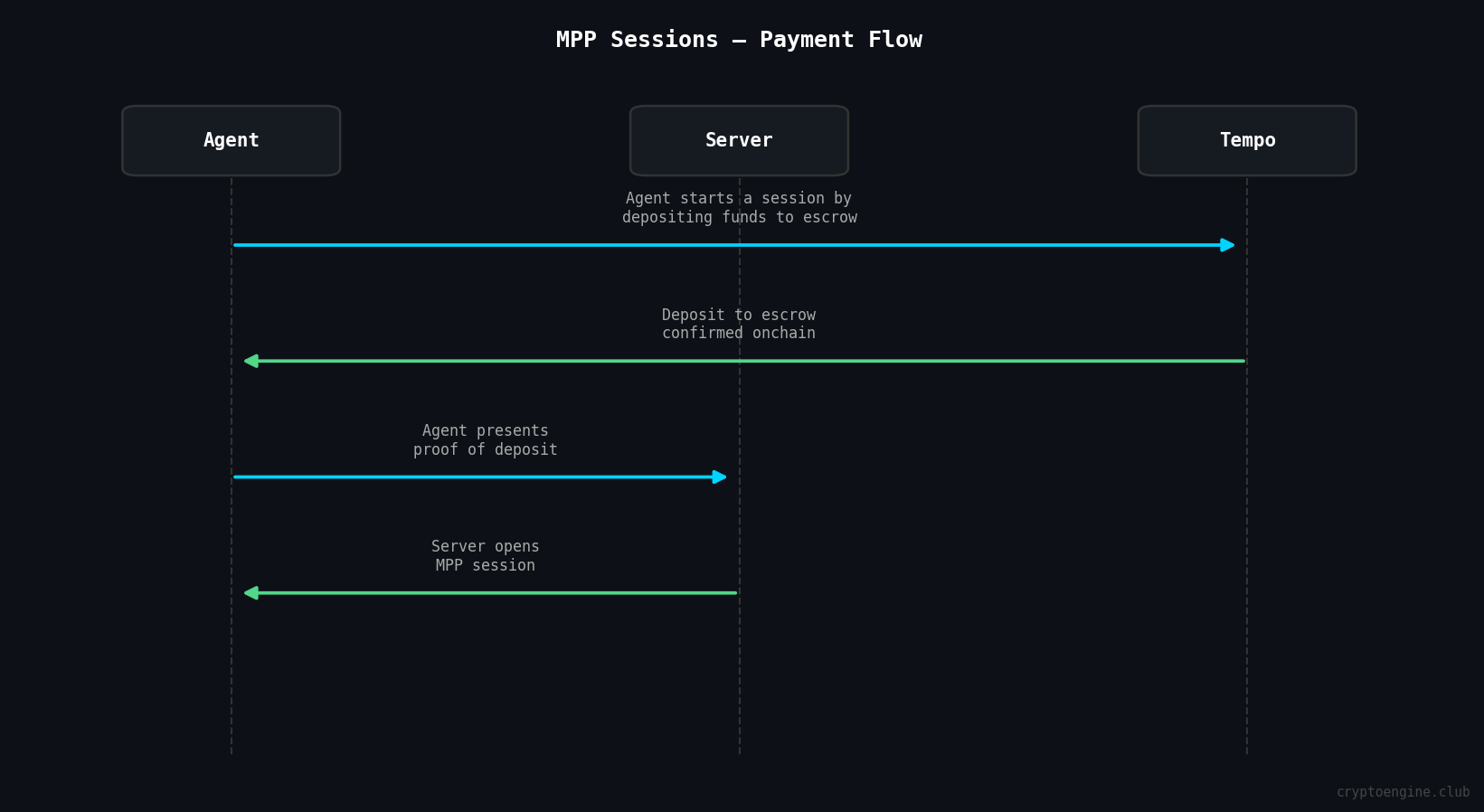
The flow works in three steps: the server returns HTTP 402 with a payment requirement in the WWW-Authenticate header (the challenge); the client submits payment proof in the Authorization header and retries (the credential); the server confirms via the Payment-Receipt header (the receipt).
MPP supports multiple payment rails: Tempo stablecoins (TIP-20), Stripe cards, Lightning BTC, Solana, and Stellar. CryptoEngine uses Tempo's TIP-20 stablecoin on Tempo mainnet.
How does the 402 payment flow work?
HTTP 402 ("Payment Required") has been in the HTTP spec since 1991. For 35 years, nobody used it. MPP is the first protocol to put it to actual use for machine-initiated payments.
Here's the exact sequence for a CryptoEngine signal call:
- Your agent POSTs to
https://cryptoengine.club/api/agent-signalwith an empty JSON body:{} - The server returns 402 with a payment challenge specifying $0.05 on Tempo mainnet (chain ID 4217), using the TIP-20 token at
0x20C000000000000000000000b9537d11c60E8b50 - Your agent's runtime satisfies the challenge by signing and submitting the payment transaction
- Your agent retries the POST with the payment credential attached
- The server validates the payment and returns the signal
The response looks like this:
{
  "direction": "LONG",
  "brief_reason": "Momentum remains positive after latest BTC trend confirmation",
  "signal_timestamp": "2026-03-29T00:00:00.000Z"
}
Three fields. direction is the trade call. brief_reason is the one-line rationale. signal_timestamp tells you when the signal was generated — check it for freshness before acting on it.
How CryptoEngine plugs into this system
CryptoEngine's agent integration is built around two public documents: a discovery endpoint and a SKILL.md file.
The discovery document at https://cryptoengine.club/api describes the available endpoints, payment settings, and chain details. It's designed for both humans debugging integrations and agents reading it before making a call.
The SKILL.md at https://cryptoengine.club/skills/crypto-engine-agent-signal/SKILL.md is structured for agent runtimes. It tells an agent exactly what to do: read the discovery doc, verify MPP support, attempt the call, handle the 402, and return the signal fields verbatim.
The agent prompt CryptoEngine ships is about as minimal as it gets:
Use Crypto Engine as a paid BTC signal source.Read this skill first: https://cryptoengine.club/skills/crypto-engine-agent-signal/SKILL.md If your runtime supports Tempo MPP on the configured network, follow that skill and call the live endpoint. If you cannot satisfy 402 Payment Required or complete Tempo payment, stop and report that limitation. When successful, return direction, brief_reason, and signal_timestamp exactly as received.
or you can do the following to install on your agent. Find out more.
npx agentcash try https://cryptoengine.club
Paste that into any agent. If it can handle MPP, it gets signals. If it can't, it stops and tells you why. No guessing, no invented data.
Does your agent runtime actually support Tempo MPP?
This is the right question before you build anything. Not all runtimes support MPP yet.
Check whether your runtime can do all of these:
- Parse a
WWW-Authenticateheader from a 402 response - Hold a Tempo wallet or connect to payment middleware
- Sign and submit a TIP-20 transaction on Tempo mainnet (chain ID 4217)
- Retry a request with the
Authorizationpayment credential attached
If your runtime clears those four checks, you can have a working integration in under an hour. If it can't, the SKILL.md tells your agent to stop and report rather than guess, invent data, or proceed without paying.
For traders who aren't building agents, the standard CryptoEngine subscription ($49/month or $99/year) is the simpler path. You get the full trade plan: entry price, stop-loss, and take-profit, not just a direction. The per-request model at $0.05/call makes more sense for automated systems running on a schedule.
Common mistakes when building against MPP-gated APIs
Caching signals past their timestamp
The response includes a signal_timestamp. Use it. A signal from 48 hours ago is not the current signal. Agents that cache responses to cut per-request costs end up trading on stale data. Read the timestamp on every call and reject anything that doesn't match your freshness threshold.
Skipping the discovery document
The /api endpoint exists so you don't hardcode payment parameters. It tells you the chain ID, token address, and cost before you build anything. If those parameters change and you've hardcoded them, your integration silently breaks. Read the discovery doc first, store the values at runtime, not compile time.
Retrying without a payment handler
Some developers wrap the signal endpoint in a retry loop without implementing the 402 handler. The agent hits the endpoint, gets 402, retries the same request without credentials, gets 402 again, and loops until timeout. MPP requires you to handle the payment challenge on the first 402 response. Same request, no credentials, won't work. It just burns time.
Frequently Asked Questions
What is the Machine Payments Protocol (MPP)? MPP is the open standard for machine-to-machine payments via HTTP 402, co-developed by Tempo and Stripe. The server issues a payment challenge when you hit an endpoint, your agent pays on the spot, and the server delivers the resource. No human setup required on either side.
How much does a CryptoEngine agent signal call cost? $0.05 per call, paid in Tempo's TIP-20 stablecoin on Tempo mainnet (chain ID 4217).
What happens if my agent can't complete the Tempo MPP payment? The SKILL.md tells the agent to stop and report the limitation. You get a clear failure message, not a silent error or an invented signal. Check your runtime's payment handling before you build, not after it fails in production.
What does the signal response include?
Three fields: direction (LONG or SHORT), brief_reason (one sentence explaining the call), and signal_timestamp (ISO 8601). The timestamp is there for a reason. Check it before acting.
How is this different from the regular CryptoEngine subscription? The subscription is for traders. You get the full plan: entry price, stop-loss, take-profit, and win/loss history across 180+ tracked signals. The agent endpoint is for builders -- direction and rationale only, priced per call. Different use case, different product.
Disclaimer: This article is for educational purposes only and does not constitute financial advice. Past performance does not guarantee future results. Always do your own research before making trading decisions.