Bitcoin Dominance at 58.4%: What It Means for BTC Traders
Bitcoin dominance is at 58.4% as of May 7, 2026, with BTC at $79,987 and RSI at 47.8. Rising dominance means capital is concentrating in BTC, not altcoins. Traders who skip this reading often get caught in rotations that cut their BTC positions short.
Bitcoin Dominance at 58.4%: What It Means for BTC Traders
Bitcoin dominance is at 58.4% as of May 7, 2026. If you are only watching price, you are missing context that changes how a signal reads.
TL;DR
- Bitcoin dominance is the percentage of total crypto market cap held in BTC. It reads 58.4% as of May 7, 2026.
- At 58.4%, BTC holds more market share than all altcoins combined. Capital is not rotating out of Bitcoin right now.
- Rising dominance typically favors BTC-focused longs. Falling dominance often signals altcoin rotation underway.
- CryptoEngine's active LONG signal entered at $78,138 on May 1, 2026. BTC is now at $79,987, up 2.4% since the signal fired.
- Dominance works as a background filter, not a standalone entry trigger.
What is bitcoin dominance?
Bitcoin dominance is the percentage of the total cryptocurrency market cap held in Bitcoin. If the entire crypto market is worth $2.74 trillion and Bitcoin accounts for roughly $1.60 trillion of that, dominance is 58.4%.
It does not measure Bitcoin's price in dollars. A trader who only watches BTC/USD can miss what dominance is actually showing: whether Bitcoin is growing its share of the overall market or losing ground to the broader altcoin ecosystem.
The difference matters in practice. You can have BTC at $100,000 and dominance at 40%. That means altcoins collectively outgrew Bitcoin at the same time BTC was making new highs. Dominance shows you where capital is sitting, not just where one asset is trading.
Why does bitcoin dominance matter for traders?
When dominance rises, two things could be happening: BTC is going up while altcoins stay flat, or the entire market is falling and BTC is holding ground better than everything else. Either way, capital is concentrated in Bitcoin. That is generally a better environment for a BTC long than a period when altcoins are outpacing it.
When dominance falls, altcoins are gaining market share. Late in a bull market, this is typically when retail money rotates out of Bitcoin and into smaller coins chasing bigger percentage moves. Holding a BTC long during falling dominance is not automatically wrong, but the money flowing into the market is no longer flowing specifically into your position.
A simple scenario map of how dominance direction and BTC price tend to interact:
| Dominance direction | BTC price direction | What it often means |
|---|---|---|
| Rising | Rising | BTC rally; alts lagging behind |
| Rising | Falling | Broad sell-off; BTC falling less than alts |
| Falling | Rising | Altcoin rotation starting; BTC still up but slower |
| Falling | Falling | Market-wide dump; alts hit harder |
These are tendencies, not rules. You will find exceptions in any timeframe. The table is a starting frame for thinking about market structure, not a trading system.
What does the current 58.4% reading signal?
As of May 7, 2026, bitcoin dominance is at 58.4% with the total crypto market cap at $2.74 trillion and BTC trading at $79,987. RSI(14) sits at 47.8 and Fear and Greed reads 47 (Neutral).
At 58.4%, dominance is above the midpoint. BTC holds more of the total market than all altcoins combined. But it is not at a cycle extreme. Bitcoin dominance has historically ranged from around 38% (altcoin season peaks) to above 65% (deep bear market consolidation). A 58.4% reading puts it in the upper-middle of that range. It is not screaming altcoin season, but it is also not the kind of flight-to-BTC pattern you see in the worst sell-offs.
The 12-month chart below shows how dominance has tracked alongside BTC price over the past year. Dominance extremes and price extremes rarely land at the same time.
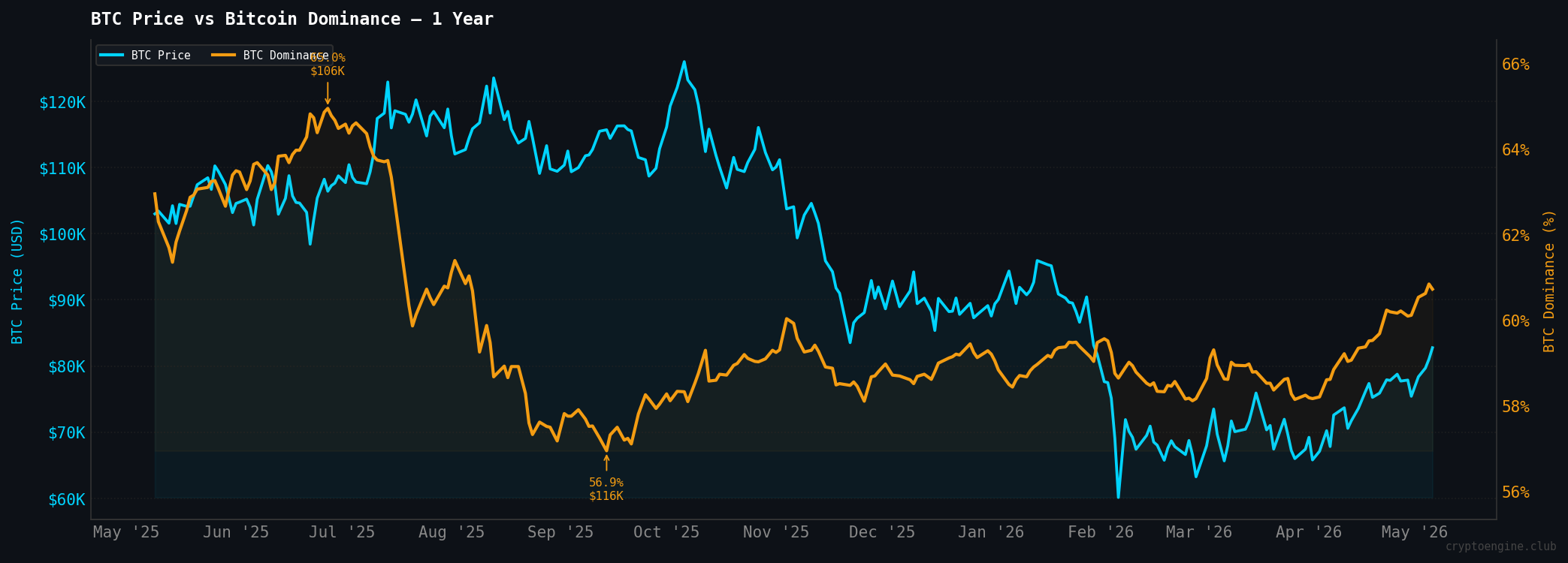
The chart covers through early May 2026. Watch for periods where dominance peaked and then dropped sharply. Those periods have historically coincided with altcoin rotation picking up speed. Conversely, periods where dominance climbed while BTC price was recovering have tended to be BTC-led recoveries with alts lagging.
Right now, dominance is holding steady rather than moving sharply in either direction. That matches the broader readings: RSI at 47.8 is neutral, and Fear and Greed at 47 shows the market has not committed to fear or greed. No single indicator is flashing an extreme.
How dominance fits into a complete trade read
Dominance is most useful when it confirms what RSI and sentiment are already showing. The current three readings together:
| Indicator | Reading | Signal |
|---|---|---|
| BTC dominance | 58.4% | BTC holding market share; no alt rotation underway |
| RSI(14) | 47.8 | Neutral momentum |
| Fear and Greed | 47 Neutral | No extreme sentiment in either direction |
When all three point in the same direction, the setup is more reliable than any one of them alone. A LONG with rising dominance plus RSI recovering from below 40 plus Fear and Greed below 30 is a more aligned read than a LONG firing while dominance is falling and sentiment is euphoric.
CryptoEngine's May 1 LONG signal entered at $78,138 with RSI in neutral territory and Fear and Greed also in the mid-40s range. BTC is now at $79,987, up 2.4% since the signal fired. None of the readings are extreme. It is a cautious long setup, not a momentum trade.
The opposite case is worth understanding too. If dominance is falling while RSI is overbought and Fear and Greed is above 80, that combination suggests BTC is extended and losing market share to altcoins at the same time. That is a weaker environment for adding to a long position.
If you want a signal that accounts for dominance, RSI, and price structure together, CryptoEngine's active signals show the current position with the full background behind each call.
Common mistakes traders make with bitcoin dominance
One of the most frequent errors: treating dominance as a buy or sell trigger by itself. Seeing dominance rise and immediately entering a long skips RSI, price structure, sentiment, and everything else. Dominance tells you about the environment. Use your actual signal to time the trade.
A second mistake is confusing falling dominance with a falling BTC price. Dominance can fall while BTC goes up. That just means altcoins are rising faster on a percentage basis. Traders who read a falling dominance chart as bearish for BTC can exit a winning long early. The real question is whether BTC price is confirming or contradicting what dominance is showing.
The third mistake is ignoring dominance during sideways markets. When BTC is range-bound, flat dominance in a narrow band reflects the same indecision. Through late April into early May 2026, BTC moved between roughly $76,000 and $82,000 with dominance largely static throughout. Dominance going nowhere is information. It tells you no major rotation is starting yet, and that this probably is not the moment to oversize a position.
Practical checklist
Before adding or adjusting a BTC position, run four checks:
- Is dominance rising, falling, or flat this week? Rising supports a BTC-focused view. Flat means wait for confirmation. Falling means check whether altcoins are specifically outpacing BTC or whether the whole market is falling.
- Is RSI confirming? Rising dominance paired with RSI recovering from below 40 is a more reliable combination than either reading alone.
- What does Fear and Greed show? Extreme fear (below 25) alongside rising dominance has preceded sharp BTC recoveries more often than not. Euphoria (above 80) alongside falling dominance is a warning to tighten stops.
- Is BTC price moving with dominance? If dominance rises but BTC price is flat or declining, something is absorbing BTC inflows without translating to price. That is a weaker setup than dominance and price moving together.
None of this requires software. A 30-second dominance check before entering a trade is enough to see whether conditions support the direction you are leaning.
Frequently asked questions
What is bitcoin dominance? Bitcoin dominance is the percentage of the total cryptocurrency market cap held in Bitcoin. If the entire crypto market is worth $2.74 trillion and Bitcoin accounts for roughly $1.60 trillion, dominance is 58.4%. It measures relative market share, not Bitcoin's price in dollars.
Is high bitcoin dominance bullish for BTC price? High dominance (above 55% to 60%) means capital is sitting in BTC rather than spread across altcoins. That is generally a better setup for a BTC long than a period when dominance is falling. But it does not guarantee price goes up. In a broad sell-off, dominance can rise while BTC price falls, because altcoins drop faster. It is most reliably bullish when paired with recovering RSI and sentiment below 30.
What does falling bitcoin dominance mean? When dominance falls, altcoins are gaining market share relative to BTC. This often happens near the end of BTC-led bull runs, when retail money rotates into smaller coins chasing larger percentage moves. Falling dominance does not mean BTC price is dropping. BTC can still be rising, but the money chasing returns is shifting elsewhere. For traders holding BTC longs, it is worth monitoring whether BTC price holds up as dominance falls.
What is a normal bitcoin dominance level? Bitcoin dominance has ranged from roughly 38% (altcoin-season peaks) to above 65% (deep bear markets where capital consolidates into BTC). The 50% to 60% range is broadly considered neutral. Above 60% is BTC-dominant territory. Below 50% usually means altcoin season is active.
How does CryptoEngine use bitcoin dominance in its signals? CryptoEngine uses dominance as one of several macro filters alongside RSI, Fear and Greed, and price structure. The system does not trade dominance directly, but dominance direction can confirm or weaken a pending signal. A LONG entering with rising dominance and recovering RSI is a more aligned setup than the same signal firing during falling dominance.
Bottom line
Bitcoin dominance at 58.4% tells you capital is concentrated in BTC and no altcoin rotation is underway. That is a reasonable background condition for a cautious long. It is not a signal on its own, but confirmation that the environment is not fighting you.
Watch whether dominance is moving, not just what level it is at. A steady reading means nothing is changing. A sharp multi-week fall in dominance toward the 50% range, while you are holding a BTC long, is worth taking seriously. If RSI and price action confirm the rollover, tighten the stop. Letting it run is how profitable positions turn.
Disclaimer: This article is for educational purposes only and does not constitute financial advice. Past performance does not guarantee future results. Always do your own research before making trading decisions.
Market data via CoinGecko.