BTC Signals vs Price Predictions: Why Signals Win
BTC trades at $61,584, up 3.6% this week despite Fear and Greed at 20 (Extreme Fear). CryptoEngine's July 1 LONG at $60,415 is up 6.5% in 5 days. A signal beats a prediction because it can be checked. A forecast almost never is.
BTC Signals vs Price Predictions: Why Signals Beat Forecasts
Every week, crypto media runs a headline predicting where Bitcoin is headed next. "BTC to $150K by year end." "Bitcoin could crash to $40K." None of those calls come with a date you can hold them to, or a plan for what to do if they're wrong. That's the real difference in the btc signals vs price predictions debate: one is a guess, the other is a trade you can check.
A price prediction is a forecast of where an asset's price will be at some future point, made without a defined timeframe or a specific action attached to it. A trading signal is different. It's a timestamped call: a direction, an entry price, and a tracked outcome that gets scored against what the market actually does.
TL;DR
- CryptoEngine's active signal went LONG on July 1, 2026 at $60,415, putting the trade up 4.7% over 3 days and 6.5% over 5 days.
- CryptoEngine's last 10 completed signals were correct 10 out of 10 times at the 5-day mark.
- BTC is up 3.6% over the past 7 days to $61,584, even with the Fear and Greed Index at 20 (Extreme Fear) and RSI(14) reading 44.5 (Neutral).
- A prediction is a single guess about a future price. A signal is a dated trade call you can verify after the fact.
What's the difference between a Bitcoin price prediction and a trading signal?
A prediction answers "where will BTC be." A signal answers "what should I do right now, and how will I know if I'm wrong." That second question is the one that actually matters when real money is on the line.
| Price Prediction | Trading Signal | |
|---|---|---|
| Timeframe | Often vague ("by year end," "eventually") | Specific window (3d, 5d, 10d) |
| Action | None implied | Direction: LONG or SHORT |
| Risk defined | No | Entry price, with stop-loss and take-profit levels |
| Accountability | Rarely revisited if wrong | Every call logged and scored |
CryptoEngine's signals are built around that right-hand column. Each one combines price structure, RSI, BTC dominance, and Fear and Greed context into a single trade plan, not a headline number. If you want to see how that compares against just holding through the noise, CryptoEngine's Q2 2026 track record breaks down the full quarter.
Why don't price predictions get held accountable?
Because nobody's forcing them to be. A prediction that BTC "will hit $150K" has no expiration date, and I've never once seen anyone go back and update the thread when it doesn't pan out. If it happens two years late, the person who made the call still gets to claim they were right. If it never happens, the post quietly gets buried under newer content.
CoinDesk's markets desk made a related point this week, writing that once headline-driven concerns fade, traders should fall back on traditional technical signals around BTC rather than the latest narrative. That's the same idea from a different angle: structure is checkable, narrative isn't.
A trading signal doesn't get that luxury. CryptoEngine's last 10 completed signals were graded at the 5-day mark, and all 10 came back correct. That's not a cherry-picked stat pulled from a screenshot. It's the full, unfiltered record, the modest wins alongside the big ones.
How CryptoEngine's signal read the July 1 reversal
Here's where the difference gets concrete. On June 30, 2026, the signal was SHORT. BTC was drifting, and the position closed at a modest +0.1% over 5 days, correct, but nothing dramatic. A day later, on July 1, the signal flipped to LONG at $60,415. The reason logged was "Downtrend breaking above resistance." Not a hunch. A specific price level giving way.
| Signal Date | Direction | 3d Return | 5d Return | 10d Return |
|---|---|---|---|---|
| 2026-07-01 | LONG | +4.7% | +6.5% | +6.5% |
| 2026-06-30 | SHORT | +0.1% | +0.1% | +0.1% |
| 2026-06-28 | SHORT | +1.1% | +1.1% | +1.1% |
| 2026-06-24 | SHORT | +4.3% | +4.3% | +4.3% |
| 2026-06-18 | SHORT | +0.8% | +1.0% | +7.4% |
That LONG is now up 4.7% over 3 days and 6.5% over 5 days. A prediction made on June 29 that "BTC keeps falling" would have missed the reversal completely, because predictions don't update. They sit there, unchanged, while the market moves on. A signal regenerates against new structure every time it fires, which is exactly why it caught the flip a static forecast couldn't.
Common mistakes traders make trusting predictions over signals
One big number becomes an anchor. Traders read "$150K by December" and hold through a 30% drawdown waiting for it to come true, ignoring what price is actually doing along the way. A signal doesn't ask you to wait on a narrative. It tells you what to do with the setup in front of you today.
The track record gets treated as evidence when it isn't one. Most price-prediction accounts never revisit the calls that missed. What gets screenshotted and shared is the one lucky hit, not the string of misses before it. CryptoEngine logs every signal, win or loss, so the record isn't curated after the fact.
A prediction has no built-in exit, and that's the part traders forget. Even a call that eventually comes true can wreck an account if you hold through a 40% drawdown to get there, because a forecast never comes with a stop-loss attached. A signal does. Entry, stop, and target get set before the trade, not improvised mid-drawdown.
How it all fits together
Right now, the setup looks like this: Fear and Greed at 20 (Extreme Fear), RSI(14) at 44.5 (Neutral), BTC dominance at 55.9%, and BTC itself up 3.6% over the past 7 days to $61,584. A prediction built purely off the sentiment reading, "everyone's scared, so it's going lower", would have been wrong. Price is climbing, not falling.
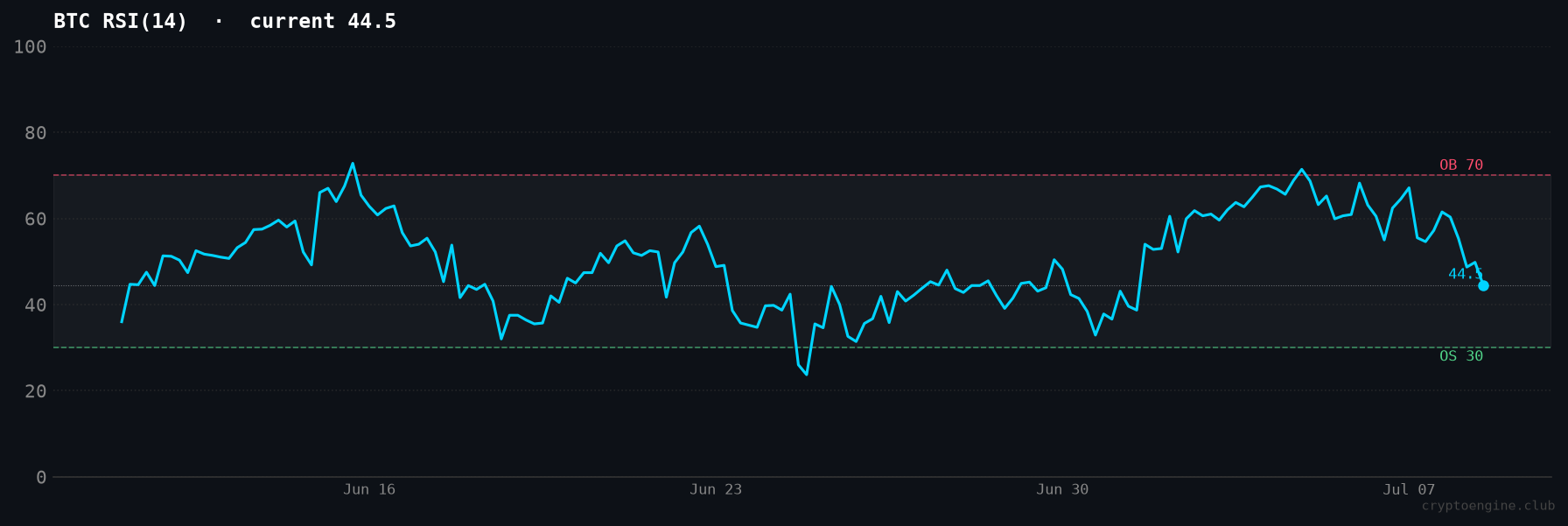
The signal that flipped LONG on July 1 wasn't reading sentiment at all. It was reading structure, a resistance level breaking, with RSI sitting neutral rather than overbought. That's the layered approach a single prediction can't replicate: sentiment, momentum, and dominance combined into one call, then checked against real returns 3, 5, and 10 days later. Want to see how that combination performs over time instead of guessing at a headline number? CryptoEngine's signals publish the full entry, stop, and target for every trade.
Frequently Asked Questions
What's the difference between a Bitcoin price prediction and a trading signal? A price prediction is a forecast of a future price with no defined timeframe or action attached. A trading signal is a specific trade call, direction, entry price, and time horizon, that gets scored against what actually happens.
Are Bitcoin price predictions ever accurate? Sometimes, by chance, but there's no consistent way to verify it because most predictions don't specify a timeframe or get revisited publicly when they miss. A hit gets shared. A miss gets forgotten.
How is a trading signal's win rate calculated? CryptoEngine grades each signal at fixed intervals, 3, 5, and 10 trading days after entry, and compares the direction called against BTC's actual move. The last 10 completed signals were correct 10 out of 10 times at the 5-day mark.
Can a trading signal be wrong? Yes. Signals are graded on the record, wins and losses both. That's what separates a signal from a prediction: every call is checkable, not just the ones that happened to work out.
Should I follow a price prediction or a trading signal? A signal gives you a specific entry, risk level, and timeframe you can act on and verify. A prediction gives you a number with no plan attached. For anyone actually placing a trade, the signal is the more useful input.
Disclaimer: This article is for educational purposes only and does not constitute financial advice. Past performance does not guarantee future results. Always do your own research before making trading decisions.