What Is Bitcoin Dominance and What It Means for Altcoins
Bitcoin dominance is at 56.2% as altcoins continue to underperform BTC. With BTC down 23.5% over 30 days and Fear and Greed at 9 (Extreme Fear), elevated dominance signals risk-off rotation, not the start of altcoin season.
What Is Bitcoin Dominance and What It Means for Altcoins
If you've been watching altcoins fall harder than Bitcoin during this selloff, bitcoin dominance is the number that explains why. It's sitting at 56.2% right now, elevated as the market remains in Extreme Fear, and it tells you something specific about where capital is sitting and what traders are avoiding.
TL;DR
- Bitcoin dominance is the percentage of total crypto market cap held in BTC. It reads 56.2% as of June 10, 2026.
- When dominance is elevated during a selloff, altcoins are falling faster than Bitcoin, not the other way around.
- The current Fear and Greed Index reads 9 (Extreme Fear) and BTC is down 23.5% over 30 days, which is why dominance remains elevated.
- Elevated dominance does not mean altcoin season is coming. It usually means alts are underperforming.
- Altcoin season historically starts only after dominance peaks, BTC stabilizes, and sentiment begins recovering.
What Is Bitcoin Dominance?
Bitcoin dominance is the percentage of the total crypto market cap represented by Bitcoin alone. With a total market cap of $2.22 trillion and BTC's market cap at roughly $1.25 trillion, dominance works out to 56.2% right now.
The formula: divide Bitcoin's market cap by total crypto market cap, multiply by 100.
What it tells you is where traders are putting and pulling their money. When BTC dominance rises, Bitcoin is taking a larger share of total market value. That can happen because BTC is rising faster than everything else, because altcoins are falling faster than BTC, or both. Right now it's the second one.
Why Is Bitcoin Dominance at 56.2% Right Now?
The short answer is fear.
BTC is down 6.7% over the past seven days and 23.5% over 30 days. But most altcoins are faring worse. Ethereum is down 11.1% in seven days and 28.8% over 30. When the Fear and Greed Index sits at 9, traders don't rotate into speculative tokens or small caps. They either exit the market entirely or consolidate into Bitcoin as the relative safe haven.
That exit from altcoins, more than any active flight into BTC, is what pushes dominance up.
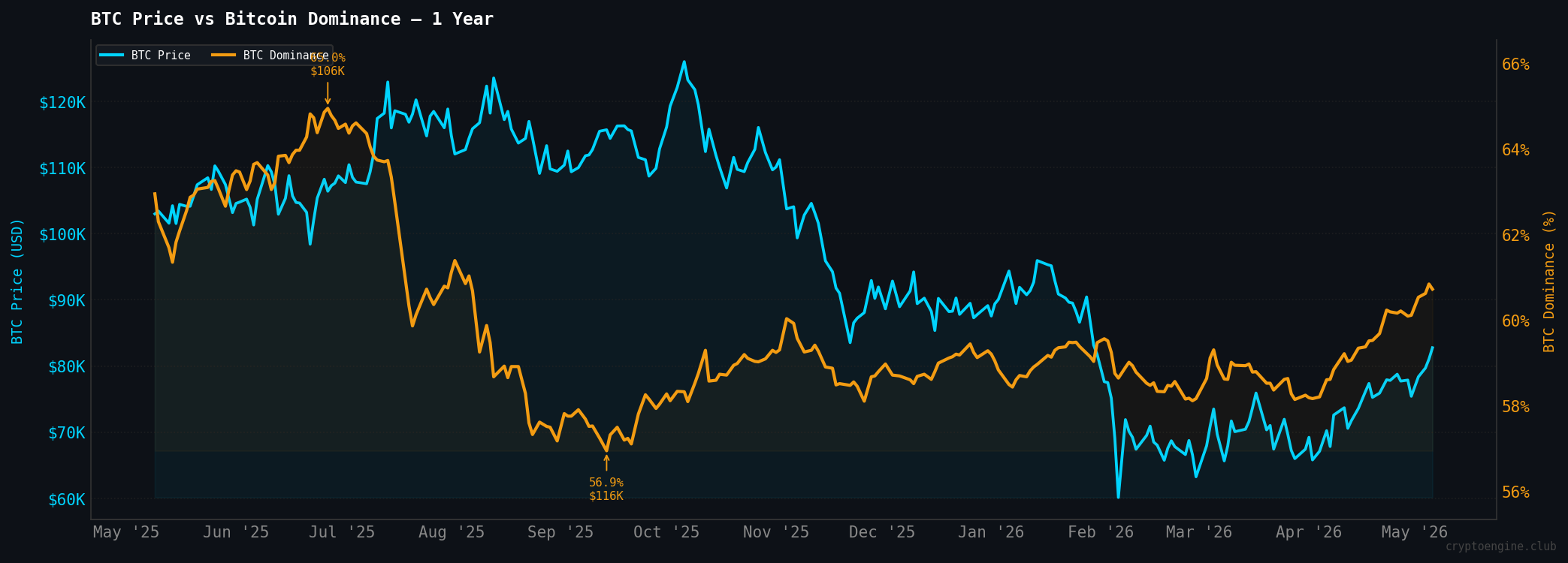
The chart below shows a year of BTC price alongside dominance. Dominance tends to spike during periods when BTC is falling and altcoins fall harder. It's a pattern that repeats at every major selloff.
What Does Rising Bitcoin Dominance Mean for Altcoins?
It's not good news if you're holding them.
When dominance rises in a bear market, it means one of two things: traders are abandoning smaller, riskier assets for Bitcoin as a fallback, or altcoins simply have no bid. Fresh capital isn't coming in. Either way, you can be correct on BTC's direction and still lose money on an altcoin position if dominance is climbing against you.
Here's a rough framework for reading dominance levels in context:
| BTC Dominance | What It Usually Signals |
|---|---|
| Below 40% | Altcoin season in progress; BTC lagging the market |
| 40–50% | Mixed rotation; neither BTC nor alts clearly leading |
| 50–60% | BTC-dominant phase; alts losing ground vs. BTC |
| Above 60% | Strong flight-to-safety; alts sharply underperforming |
At 56.2%, we're in the BTC-dominant zone. Altcoins can still bounce from here, but this is not a favorable backdrop for alt-heavy portfolios.
One important nuance: dominance doesn't treat all altcoins equally. Some tokens move on their own catalysts and can post gains even when the macro reading is bearish. The macro number gives you the overall picture, but token-level setups can diverge sharply. Don't use a single dominance reading to make token-level bets without looking at the specific setup.
How Does Bitcoin Dominance Interact With Fear and Greed?
These two readings confirm or contradict each other, and paying attention to which is happening matters.
Right now they agree directionally. Fear and Greed at 9, dominance at 56.2%. Capital is still in BTC, alts remain under pressure, and nothing in either reading suggests a rotation is underway.
The more nuanced scenario to understand is when they diverge. If sentiment starts recovering while dominance keeps climbing, that usually means BTC is leading a bounce but altcoins haven't participated yet. That's a BTC-first setup. The signal that alt rotation is actually beginning is dominance peaking and turning lower alongside improving sentiment, not just dominance sitting at a high level.
Right now that turn hasn't happened. Dominance is elevated and sentiment is in the basement. The setup doesn't favor altcoins.
How Does CryptoEngine Read BTC Dominance?
CryptoEngine's signals focus on BTC, not altcoins. But dominance is part of the market context that shapes how signal thresholds get read.
Here's why it matters: when dominance is elevated in a fear environment, it tells you where capital is positioned. A signal firing in that context carries different implications than one firing during a low-dominance rotation phase. Dominance remaining high while BTC attempts a bounce — the current setup — means altcoins haven't recovered yet, which limits how far a risk-on rally can run.
The previous SHORT, entered at $66,316 on June 2, returned +10.5% over five days. CryptoEngine then switched to a LONG on June 8 at $63,405 as BTC showed signs of a potential reversal. That LONG is currently down 1.1% with BTC at $62,734. Dominance staying at 56.2% while the LONG is active confirms the broader market hasn't rotated back into risk yet — BTC may be stabilizing, but alts aren't leading.
If you want to see the specific entry, stop-loss, and take-profit levels on this and past signals, CryptoEngine's signal tracker logs every trade. It's useful for understanding how signal setups and market context combine in practice, not just in theory.
Common Mistakes Traders Make With Bitcoin Dominance
The most common one is treating rising dominance as a buy signal for altcoins. When dominance is climbing, alts are usually being sold. Some traders see 56% and think it's a good time to load up before a bounce. That can work near a dominance peak, but you need confirmation that dominance is actually turning lower, not just hovering high. Without that turn, you're buying into ongoing outflows.
Second mistake: using dominance alone to call altcoin season. A drop from 60% to 55% doesn't mean alt season has started. BTC needs to stabilize first. Then Fear and Greed needs to recover. Then you need actual capital flow into specific sectors. Dominance is a directional indicator, not a precise timing tool, and reading it in isolation leads to early calls.
Third: ignoring that dominance can rise even when BTC is falling. A lot of traders assume rising dominance means BTC is pumping. It doesn't. It just means BTC is falling less than everything else. Right now BTC is down 23.5% over 30 days. The fact that dominance is at 56.2% reflects how much harder alts are getting hit, not any strength in BTC itself.
How It All Fits Together
Bitcoin dominance, RSI, and Fear and Greed are three separate reads on the same market, and they're most useful when they agree.
Right now the picture is mixed. Fear and Greed at 9 signals panic selling is still present. RSI at 50.1 is neutral — not oversold, not overbought — which means momentum has stalled without a clear directional commitment. And dominance at 56.2% confirms that capital is still concentrated in BTC while alts lag.
Together that three-indicator read says: the market is risk-off, no sustained rotation into altcoins is underway, and BTC is trying to stabilize but hasn't built momentum. A sustained drop in dominance, RSI holding above 50, and Fear and Greed recovering above 25 would be the combination to watch for a potential shift in tone.
For signal interpretation, this kind of macro context is what shapes how CryptoEngine reads individual setups. The current LONG, entered June 8 as BTC showed signs of a reversal, is operating in exactly this ambiguous backdrop: sentiment remains fearful, dominance is still elevated, but RSI has recovered to neutral.
You can learn more about how RSI fits into the picture in How to Read BTC Candlestick Charts: Patterns That Matter.
Frequently Asked Questions
What is Bitcoin dominance? Bitcoin dominance is the percentage of the total cryptocurrency market capitalization held in Bitcoin. It is calculated by dividing Bitcoin's market cap by the total crypto market cap. As of June 10, 2026, BTC dominance reads 56.2%, with a total market cap of $2.22 trillion.
Why is Bitcoin dominance elevated during a market crash? During sharp selloffs, traders typically exit riskier altcoins before they exit Bitcoin. Because altcoins fall faster than BTC, Bitcoin's share of total market cap increases even while BTC itself is declining. BTC is down 23.5% over the past 30 days, but most altcoins are down considerably more.
Does high Bitcoin dominance mean altcoin season is coming? Not necessarily. High dominance signals that capital is in BTC rather than altcoins. Altcoin season typically starts after dominance peaks and begins falling, BTC stabilizes, and sentiment starts recovering. None of those conditions are clearly present right now, with Fear and Greed at 9 and dominance still elevated.
What Bitcoin dominance level signals an altcoin opportunity? There is no single threshold. Dominance dropping below 50% after a peak is commonly cited as an early sign of alt rotation, but the direction matters more than the level. A drop from 60% toward 50% with improving Fear and Greed is a useful combination. A reading of 48% that's still falling is more bullish for alts than 52% that just turned up.
How does Bitcoin dominance affect BTC trading signals? For BTC-focused signals, dominance is a confirming indicator rather than a trigger. Elevated dominance in a fear environment adds weight to bearish setups — the whole market is rotating toward BTC rather than speculating into risk assets. When dominance stays high as BTC tries to bounce, it tells you the recovery hasn't broadened out yet. CryptoEngine's current LONG, entered June 8 at $63,405, is operating in exactly that kind of ambiguous backdrop.
Disclaimer: This article is for educational purposes only and does not constitute financial advice. Past performance does not guarantee future results. Always do your own research before making trading decisions.
Market data via CoinGecko. News sources: CoinDesk, Decrypt. ===ARTICLE_END===