Bitcoin Trading Signals: How BTC Dominance Changes Them
The new 1-year dominance chart shows BTC leadership has stayed elevated even through sharp price swings. BTC dominance is most useful as a capital-rotation signal, not a standalone price call.
Bitcoin Trading Signals: How BTC Dominance Changes Them
A bitcoin trading signal is only useful if you can read the market around it. Entry, stop loss, and take profit tell you what to do. Bitcoin dominance answers a different question: is BTC leading, or is money starting to move elsewhere?
Bitcoin trading signals are trade ideas that include a direction, an entry, a stop loss, and a take-profit target.
As of April 14, 2026, Bitcoin trades at $74,047 and the weekly brief puts Bitcoin dominance at 57.3%. That matters because BTC is still holding more than half of the total crypto market cap. In practical terms, this is still a Bitcoin-led market.
TL;DR
- Bitcoin trades at $74,047 on April 14, 2026, with BTC dominance at 57.3%.
- CryptoEngine's active LONG signal fired on April 5, 2026 at $66,957 and is up 10.6%.
- The new 1-year chart shows BTC dominance stayed elevated through multiple price swings, which points to persistent BTC leadership rather than a broad altcoin regime.
- Rising or elevated BTC dominance usually supports BTC-focused long setups more than altcoin rotation trades.
- Bitcoin dominance is more useful for reading capital rotation than for predicting the next BTC candle.
What Is a Bitcoin Trading Signal?
A bitcoin trading signal is a structured trade setup. At minimum, it should tell you four things:
- Whether the trade is
LONGorSHORT - Where to enter
- Where to place the stop loss
- Where to take profit
That is the difference between a real signal and a vague opinion. "BTC looks bullish" is not a signal. "LONG BTC at X, stop at Y, take profit at Z" is.
For beginners, this matters more than most people think. A direction without risk parameters turns every trade into improvisation. That is how traders end up holding losers too long and cutting winners too early.
If you want the full foundation first, this piece pairs well with Bitcoin RSI: How to Use It for Entry and Exit Signals and When to Take Profit on Bitcoin.
How Do You Read Entry, Stop Loss, and Take Profit in Bitcoin Signals?
Start with the entry. This is the price level where the trade idea becomes active. A good entry is tied to structure, not guesswork. That could be a breakout, a reclaim, or a support hold.
Then look at the stop loss. The stop is the price that proves your idea was wrong. It is not there to protect your emotions. It is there to cap the damage when the setup fails.
Then look at take profit. This is the point where the original edge has likely played out and the risk of staying in the trade starts getting worse.
A clean way to read a signal is:
- What is the market direction?
- What price confirms the setup?
- What price invalidates it?
- What price likely completes the move?
If any one of those is missing, the signal is incomplete.
What Does Bitcoin Dominance Mean for BTC Signals?
Bitcoin dominance is the percentage of the total crypto market cap held in BTC.
That number matters because it shows where capital is concentrating. When dominance is high or rising, traders are leaning toward BTC instead of spreading risk across altcoins. When dominance is falling, more money is rotating away from BTC into the rest of the market.
At 57.3% on April 14, 2026, BTC dominance is still elevated. That does not automatically mean every long signal is correct. It does mean BTC remains the part of the market attracting the most attention and liquidity.
For signal reading, the practical takeaway is simple:
- Higher or rising dominance usually makes BTC long setups cleaner than altcoin chases
- Falling dominance can weaken the case for BTC-only strength and improve the odds of broader risk-taking
- Stable but elevated dominance often means traders still trust BTC more than the rest of crypto
This is why dominance belongs in your signal process. It tells you whether Bitcoin is winning the relative-strength battle against the rest of crypto.
What Does the Historical BTC Dominance Chart Actually Show?
The chart matters because it gets this topic out of theory.
The last year does not show a clean rule like "higher dominance means higher BTC price" or "lower dominance means lower BTC price." What it shows is more useful than that. It shows whether BTC is taking share of the market while price moves.
Some stretches show BTC price and dominance rising together. That usually means Bitcoin is carrying the move and altcoins are not keeping up. Other stretches show BTC rising while dominance softens. That usually means money is spreading into alts as the rally broadens.
That is the right way to use the metric. Do not ask, "What does dominance say BTC will do tomorrow?" Ask, "Is Bitcoin leading this tape or sharing leadership with the rest of the market?"
How Does BTC Dominance Change Long and Short Bitcoin Signals?
This is where the topic gets useful.
A LONG bitcoin signal in a high-dominance environment usually means traders are choosing BTC as the safer place to express crypto risk. If price is breaking higher and dominance is also firm, that is a cleaner backdrop than a rally driven purely by short covering.
A SHORT bitcoin signal in a high-dominance environment is trickier. If capital is still crowding into BTC, bearish BTC trades can take longer to work cleanly. You may still get the short. You just want better confirmation before taking it.
If dominance is falling hard, the read changes. BTC can still rise, but the market is signaling that traders are rotating out of BTC leadership. In that environment, a BTC long may have less follow-through than it would in a rising-dominance tape.
That is why "long vs short bitcoin signals" is not just a direction call. The same signal can have different odds depending on where dominance is going.
A Real BTC Signal Example With the Current Market
CryptoEngine's active signal is a useful example because the numbers are live.
The current signal is LONG. It has been active since April 5, 2026, with an entry at $66,957. As of April 14, 2026, BTC is at $74,047, which puts the move up 10.6% since the signal fired.
The reason on the signal was: "Downtrend breaking above resistance."
Now add the broader context:
- BTC price: $74,047
- BTC dominance: 57.3%
This is the kind of setup traders like to see in a BTC-led tape. Price broke higher and dominance stayed elevated, which suggests money is still concentrated in BTC rather than rotating aggressively into altcoins.
The new chart below is the better way to read this topic. It plots BTC price against Bitcoin dominance over the last year instead of borrowing momentum or sentiment visuals from other articles.
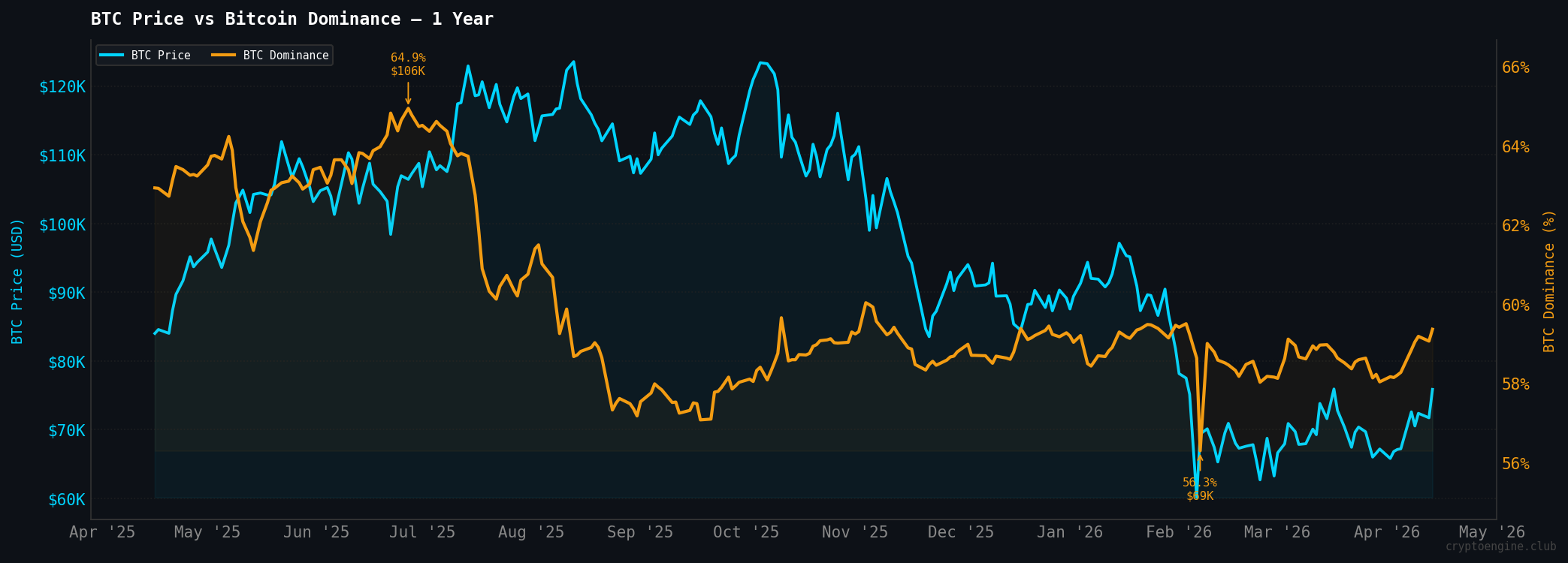
The point is not that dominance predicts price in a straight line. It does not. The useful read is whether BTC is leading the market or simply rising alongside a broader crypto move. When dominance climbs with price, BTC is carrying more of the market. When price rises while dominance fades, money is spreading further out into alts.
The chart uses a derived dominance series from BTC market cap divided by total crypto market cap over time, so the latest plotted reading may differ slightly from the spot dominance figure in the weekly brief.
For this article, that chart is the main evidence. It gives you a much cleaner read on BTC leadership than a single daily snapshot ever could.
How Should Beginners Use Bitcoin Trading Signals?
Beginners should treat bitcoin trading signals as decision frameworks, not magic alerts.
A good process looks like this:
- Read the direction:
LONGorSHORT - Check whether the entry level has actually been hit
- Place the stop loss before the trade moves
- Decide position size based on the stop, not the dream outcome
- Check context: especially BTC dominance, so you know whether BTC is leading or lagging the broader market
The biggest mistake beginners make is copying the direction and ignoring the rest. They buy because the signal says LONG, then improvise the stop, move the stop, and hold past the take-profit plan. At that point, they are not following the signal anymore.
If you are swing trading, this is even more important. Swing traders are holding for days, not minutes. That means market context matters more. A BTC swing trade usually has better odds when dominance is supportive and the market still looks Bitcoin-led.
Common Mistakes Traders Make With Bitcoin Signals
Mistake 1: Treating dominance as a prediction instead of context
Bitcoin dominance does not tell you where BTC goes next by itself. It tells you where capital is concentrating right now. Traders who read 57.3% dominance as a guaranteed bullish signal are reading too much into one number.
Mistake 2: Entering the trade but skipping the stop loss
This is the oldest mistake in the book. Traders copy the entry, tell themselves they will "manage it manually," and then freeze when price moves against them. A signal without a respected stop loss is not risk management. It is hope.
Mistake 3: Chasing altcoins while BTC dominance is still firm
When BTC dominance is elevated, traders are still favoring BTC. That does not mean alts cannot rally. It means the cleaner money is still leaning toward Bitcoin. Ignore that and the usual result is weaker entries and noisier trade management.
Tools like CryptoEngine help here because the signal is not just a direction call. It is a complete trade plan that already layers in structure and BTC-dominance context instead of treating every BTC move like it happens in isolation.
How It All Fits Together
As of April 14, 2026, the market reads like this: BTC at $74,047 and BTC dominance at 57.3%. The 1-year chart shows BTC has kept an elevated share of the market through multiple price regimes. That is the main point.
Price is strong, and capital is still concentrated in BTC. That combination supports the current LONG signal far more than a market where BTC was rising but dominance was clearly rolling over and altcoins were taking share.
This is the real job of BTC dominance in a signal framework. Entry tells you where to act. Stop loss tells you where you are wrong. Take profit tells you where the edge may be spent. Dominance tells you whether Bitcoin is leading the move or just along for it.
If you want that logic packaged into a single process instead of checking each input manually, see how CryptoEngine's bitcoin signals are structured.
Frequently Asked Questions
What is a bitcoin trading signal? A bitcoin trading signal is a trade setup with a direction, entry, stop loss, and take-profit level. It is more specific than a market opinion because it tells you exactly when the idea is valid and when it is wrong.
How do you read a bitcoin signal correctly? Read the direction first, then the entry, stop loss, and take profit. After that, check market context, especially BTC dominance, to judge whether Bitcoin is leading the market or losing relative strength.
What does Bitcoin dominance mean for trading signals? Bitcoin dominance measures the share of total crypto market cap held in BTC. Higher or rising dominance usually means capital is staying concentrated in Bitcoin, which can improve the backdrop for BTC-focused long trades.
Does rising Bitcoin dominance guarantee BTC price will go up? No. Rising dominance means Bitcoin is taking market share, not that price must rise immediately. BTC can still fall while dominance rises if altcoins are falling even harder.
What is the difference between a long and short bitcoin signal? A long signal expects BTC price to rise from the entry level. A short signal expects BTC price to fall. The trade direction is only part of the picture. The stop loss and the surrounding market context decide whether the setup is actually worth taking.
Are bitcoin signals useful for swing traders? Yes, if they include full risk parameters and if the trader understands the context around them. Swing traders especially need to care about momentum, sentiment, and BTC dominance because they are holding through multi-day market moves.
Disclaimer: This article is for educational purposes only and does not constitute financial advice. Past performance does not guarantee future results. Always do your own research before making trading decisions.
Market data via CoinGecko and historical chart data via CoinCodex. News sources: CoinDesk, Decrypt, The Block.