Bitcoin Volatility Explained: What BTC Traders Need to Know
Bitcoin volatility is how much BTC swings in a given period. With RSI at 65.0 and Fear & Greed at 71 (Greed), BTC's +13% move in 7 days shows exactly why accounting for volatility is the difference between a well-sized trade and an avoidable loss.
Bitcoin Volatility Explained: What It Means for Your BTC Positions
Bitcoin's price just moved 13% in seven days. That kind of swing is completely normal for BTC, and it's exactly what catches traders flat-footed if they haven't sized their positions for it.
Bitcoin volatility is the measure of how much BTC's price moves over a given time period. High volatility means bigger swings in both directions. Low volatility means tighter ranges and less movement per session.
TL;DR
- Bitcoin's 7-day ranges regularly exceed 10%, compared to under 2% for most stock indices.
- As of 2026-09-23, BTC is at $84,148 after a 13% move in 7 days, with RSI at 65.0 and Fear & Greed at 71 (Greed).
- Volatility itself is not the problem. Not accounting for it when you size positions and set stops is.
- The three most expensive mistakes in volatile markets: chasing moves after they've extended, setting stops too tight, and carrying full position size when daily ranges double.
Why is Bitcoin so volatile?
BTC doesn't have the stabilizers most assets do. No central bank steps in when it drops 20%. No circuit breakers halt trading. No earnings calendar anchors price to fundamentals at predictable intervals.
What you get instead is a 24/7 global market with a fixed supply cap, a relatively small float (most long-term holders don't actively trade), and retail sentiment that can shift from greed to panic inside a single news cycle.
The market structure makes swings worse. Because BTC's market cap is still smaller than most large-cap indices, large trades move price more. A few billion dollars in forced liquidations can push BTC down 10% in hours. In the S&P 500, that same dollar amount barely registers on the daily chart.
There's also a feedback loop: high volatility attracts more speculative traders, which increases volatility further. This cycle runs until momentum exhausts itself or a major catalyst breaks it.
How to measure bitcoin volatility
Most traders talk about volatility loosely ("BTC is going crazy"), but there are specific ways to think about it when it affects your actual trades.
Realized volatility looks at how much BTC actually moved over a past window, typically 30 or 90 days. If BTC moved an average of 2.5% per day over the last 30 sessions, that's your baseline for what "normal" looks like right now.
Implied volatility comes from BTC options pricing. It's what the market expects future swings to be. Elevated implied vol means large-money participants are paying up to hedge or speculate on big moves.
For most retail traders, neither metric needs to be calculated manually. The practical question is simpler: how wide does my stop-loss need to be to survive the typical daily range, and how does that affect my position size?
Here's a rough reference based on BTC's historical volatility environments:
| Volatility environment | Typical daily range | Stop-loss rule of thumb |
|---|---|---|
| Low (calm market) | 0.5% to 1.5% | 3-5% below entry |
| Medium | 1.5% to 3.5% | 5-8% below entry |
| High (volatile) | 3.5% to 6%+ | 8-12% below entry |
Setting a 2% stop in a market moving 4% intraday isn't risk management. It's a guarantee you'll get stopped out on noise before any real move plays out.
What does high bitcoin volatility mean for your trades?
It means your position sizing math needs to change. A rule that works in a calm market can be damaging in a volatile one.
Here's the issue: if you're risking a fixed dollar amount per trade but BTC's stop-loss needs to be twice as wide in volatile conditions, your position size needs to be half as large to keep the same dollar risk. Most traders skip this adjustment. They keep the same size, set a wider stop "because volatility is high," and end up taking a loss that's twice what they planned for.
The 1% risk rule is the floor: never risk more than 1% of your account on any single BTC trade. In volatile markets, consider dropping that to 0.5%. If you want to walk through the actual math, the piece on how to size your Bitcoin position covers it in detail.
Your entry price also matters more when volatility is elevated. In a calm market, being $200 off your ideal entry is usually fine. In a volatile market, a worse-than-planned entry combined with a wider stop means you're taking substantially more risk for the same potential reward.
The RSI and BTC price chart below shows how volatility clusters around momentum extremes. When RSI spikes above 70 or drops below 30, daily ranges tend to expand sharply.
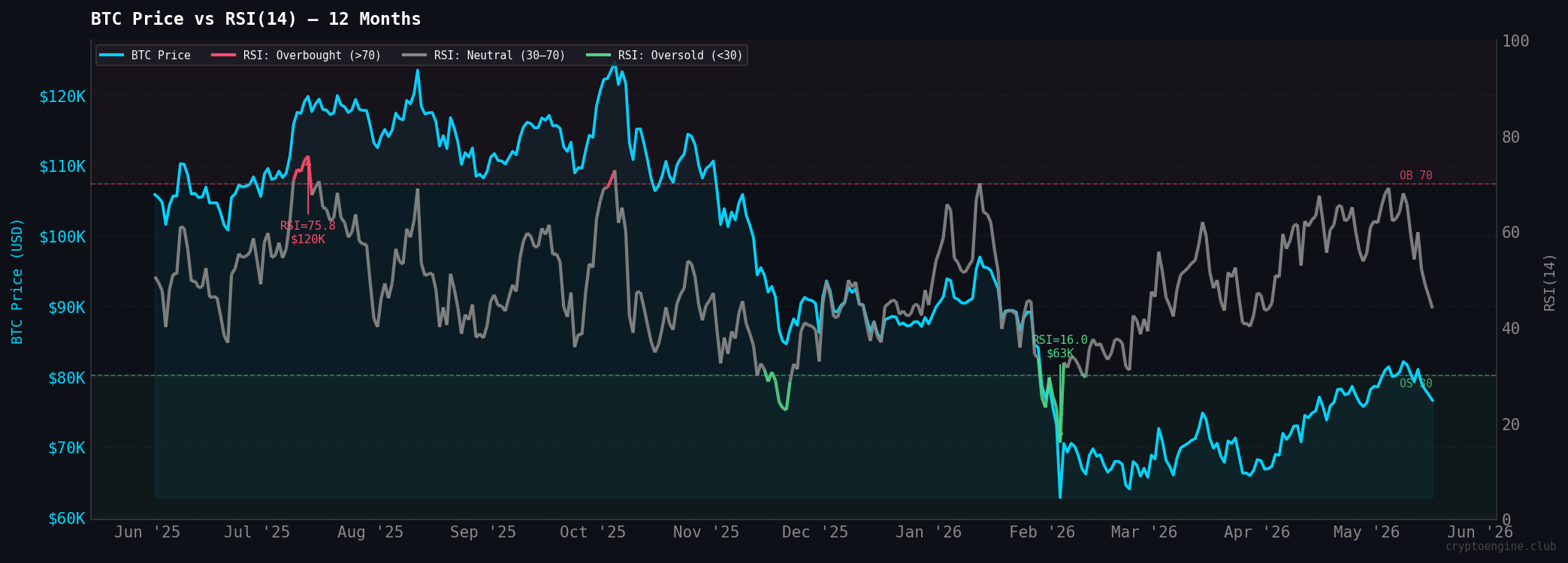
With RSI at 65.0 and BTC up 13% in 7 days, we're in a momentum-driven environment right now. Not extreme, but the kind of stretch where pullbacks can be fast and sharp when they come.
Common mistakes traders make during volatile periods
The most common error: chasing a move that's already extended. BTC runs from $79,977 to $84,148 in five days. You see the momentum and buy near the top, right before a 6% pullback. Volatility works in both directions, and late entries usually catch the reversal more than the continuation.
The second most costly mistake is a stop-loss set too close to the entry price. In a market printing 2-3% intraday swings, a 2% stop below your entry is just noise. You'll get taken out on a wick that never even closes below your level, then watch price continue to your original target without you. Getting stop-loss placement right means working backward from the actual daily range, not just picking a round-number percentage.
The third one is running full position size during a high-volatility run because momentum feels strong. Fear & Greed at 71 is not a guarantee of continuation. The same conditions that pushed BTC up 13% this week can reverse hard when sentiment shifts. Carrying your largest positions into extended momentum is how traders turn a correct directional call into an overexposed, uncomfortable hold.
How CryptoEngine thinks about volatility
CryptoEngine's signal approach doesn't treat volatility as a problem to work around. It's built into the entry framework: every signal comes with a specific stop-loss calibrated to current conditions, not a default fixed-percentage level.
When a signal fires in a high-volatility environment, the stop needs more room. That means the position size is smaller, the risk per trade stays consistent, and the trade still makes sense even if BTC chops 4% before finding direction.
CryptoEngine has logged every signal publicly since April 2026. Its last 10 completed signals returned a 10/10 win rate over 5-trading-day windows. That record isn't about ignoring volatility. It's about building volatility into every trade plan from the start.
The current active LONG signal (since 2026-09-18, entry at $79,977) is up 5.2% with BTC at $84,148. The position survived the normal intraday noise because the stop was placed correctly for current conditions, not set tight to minimize theoretical loss.
Want to see how the signal-with-volatility approach works in practice? See CryptoEngine's track record and pricing →
A practical pre-trade checklist for volatile markets:
Before entering any trade when daily ranges are elevated:
- Check BTC's actual daily range over the last 5 sessions. Is your stop-loss wide enough to survive what the market has been doing?
- Recalculate your position size based on the stop distance and your risk limit (1% of account, or 0.5% in high-volatility conditions).
- Use limit orders. Market orders in volatile conditions often fill at a significantly worse price than expected.
- Know exactly what you'll do if BTC drops 5% immediately after your entry. If the answer is "I'm not sure," your position is probably too large.
- Don't chase a move that happened while you were watching. The setup you missed is never as good as it looks in hindsight.
How it all fits together
Volatility doesn't show up in isolation. When BTC moves sharply, RSI tends to push toward momentum extremes, and the Fear & Greed Index follows sentiment. Right now: BTC at $84,148, RSI at 65.0, Fear & Greed at 71 (Greed). That combination puts us in an extended momentum run, but not at the kind of extreme that historically precedes sharp reversals.
The signal framework reads these together. A 13% weekly move with RSI below 70 and Fear & Greed not yet above 80 can continue, but the risk of a fast pullback grows as the move extends. That's the context where the RSI and sentiment timing framework matters most: knowing when the risk/reward starts shifting against you, even if price is still moving in your favor.
In volatile conditions, your entry, stop-loss, and position size are the three decisions that determine your outcome. Get those right and volatility stops being the thing that wrecks you. It's just the conditions you're working in.
Frequently Asked Questions
What is bitcoin volatility? Bitcoin volatility is the measure of how much BTC's price fluctuates over a given time period. Higher volatility means larger and more frequent price swings in both directions. BTC is historically more volatile than most traditional assets, with typical daily ranges of 1-4% and monthly ranges that can exceed 20-30% in trending environments.
Why is Bitcoin more volatile than stocks? BTC has a smaller market cap than major stock indices, no central bank backstop, 24/7 trading without circuit breakers, and a larger proportion of speculative and retail participants. When sentiment shifts, there's less structural buying to slow the move. That makes price swings faster and larger than in most traditional markets.
Is high bitcoin volatility good or bad for traders? It depends on whether you've adjusted for it. High volatility creates larger profit opportunities, but it also means larger potential losses if you're not sized correctly for the current environment. Traders who build volatility into their position sizing and stop-loss placement can do well in volatile conditions. Those who don't adjust often give back gains quickly.
How do you trade Bitcoin during high volatility? Use smaller position sizes, consider dropping from 1% risk per trade to 0.5%, widen your stop-losses to account for the larger intraday range, use limit orders instead of market orders, and don't chase moves that have already extended significantly. High volatility is when overexposure punishes hardest.
Does the Fear & Greed Index predict bitcoin volatility? Not directly, but there's a correlation. Extreme Fear readings (below 25) and Extreme Greed readings (above 75) tend to coincide with higher volatility. When sentiment is at extremes, more traders are reacting emotionally rather than systematically, which amplifies price moves. The index is more useful as a sentiment context than as a precise volatility predictor.
Disclaimer: This article is for educational purposes only and does not constitute financial advice. Past performance does not guarantee future results. Always do your own research before making trading decisions.
Market data via CoinGecko.