How to Set a Bitcoin Stop-Loss Without Getting Swept
A Bitcoin stop-loss closes your position automatically when BTC moves against you. With Fear & Greed at 27 (Fear) on July 17, 2026, placement is the whole game. Put it below confirmed support, not at round numbers where stops get swept.
How to Set a Stop-Loss for Bitcoin Trading
Most traders think about entries. They spend hours watching charts, reading signals, waiting for the right moment to buy. Then BTC drops 8% overnight and they freeze. No bitcoin stop loss. No plan. Just a loss that keeps getting worse.
A bitcoin stop loss is the thing that removes that decision from you.
TL;DR
- A bitcoin stop-loss is an order that automatically exits your position if BTC falls to a price you set in advance.
- Placing your stop at a round number like $60,000 is the most common mistake: those levels concentrate with other stops and get swept.
- Support-based stops, placed just below a confirmed price floor, survive normal BTC volatility better than fixed percentages.
- CryptoEngine's signals include a specific stop-loss level with every alert, based on technical structure at the time of entry.
- With Fear & Greed at 27 (Fear) and BTC at $64,136 as of July 17, 2026, this is exactly the kind of market where a well-placed stop keeps you in the trade.
What is a stop-loss in Bitcoin trading?
A bitcoin stop-loss is a pre-set exit order that closes your position automatically if BTC falls to a price you specify. You enter a trade, set the stop below your entry, and if price drops to that level, you're out. No further decision required.
That sounds simple. The tricky part is where to put it.
Set it too tight and you get stopped out by normal intraday noise before the trade has a chance to develop. Set it too loose and you're absorbing a large loss before the market confirms you were wrong. A good bitcoin stop loss triggers only when the trade thesis breaks down at the structural level, not from routine volatility or a temporary dip.
Why do most Bitcoin stop-losses fail?
BTC's volatility is the main issue. In a quiet week, BTC can swing 3-5% without any change in trend. In the fear-driven markets we saw through mid-2026 (Fear & Greed below 30, daily ranges expanding), that figure doubles. Traders who set a 2% stop below entry get washed out on normal price action. Then BTC recovers and they've missed the trade they were originally positioned for.
The second failure is round numbers. If you're long BTC at $64,000 and you set your stop at $62,000, so did a lot of other traders. Liquidity providers know where stops cluster. Price routinely dips just below obvious round-number levels, triggers the stops, then reverses. You exit at $62,000, BTC bounces to $65,000, and you watch from the sideline. It's not a conspiracy. It's what happens when stop orders pool at predictable levels.
The fix for both problems is to stop placing your bitcoin stop loss at predictable levels.
Three methods for placing a Bitcoin stop-loss
There's no single right answer. The best method depends on your time frame, the trade setup, and how much volatility you're willing to absorb.
1. Support-based stops
This is the most reliable method for discretionary BTC traders. You find the most recent confirmed support level (a price floor the market has already tested and held) and place your stop just below it.
If BTC has been ranging between $60,000 and $66,000, and support has held twice at $60,000, your stop might sit at $59,200 to $59,500. Below the floor, but not so far below that you're giving up massive ground.
The logic is direct: if support breaks, the trade thesis is wrong. You should be out. If support holds, the stop stays untouched and the trade has room to develop.
2. Percentage-based stops
Some traders use a fixed percentage from entry (5%, 8%, 10%) regardless of technical structure. Simple and consistent. The problem: it ignores conditions.
A 5% stop in a low-volatility market is reasonable. A 5% stop when BTC is swinging 10% daily is almost guaranteed to trigger before the trend resolves. If you use this method, adjust the percentage based on current volatility. Higher daily ranges require a wider stop, or a smaller position to keep the dollar risk constant.
3. ATR-based stops
ATR (Average True Range) measures how much BTC is moving on average over a set number of days. If the 14-day ATR is $3,200, placing your stop 1x or 1.5x ATR below entry roughly accounts for normal daily swings. The stop adapts to conditions automatically: wider in volatile periods, tighter when BTC is quiet.
Here's how these three approaches compare on a hypothetical LONG at $64,136 (BTC's price on July 17, 2026):
| Method | Stop Logic | Approximate Stop | Risk Per BTC |
|---|---|---|---|
| Support-based | Below $60,000 confirmed floor | ~$59,200 | ~$4,936 |
| 5% fixed | 5% below entry | $60,929 | $3,207 |
| 10% fixed | 10% below entry | $57,722 | $6,414 |
| 1.5x ATR | 1.5x recent daily range | Varies | Varies |
Support-based is generally the most accurate. The fixed-percentage approach is easier but blind to structure. ATR-based is good for mechanical systems. Most traders combine two of these: they start with a support level and then check that the distance is consistent with current volatility.
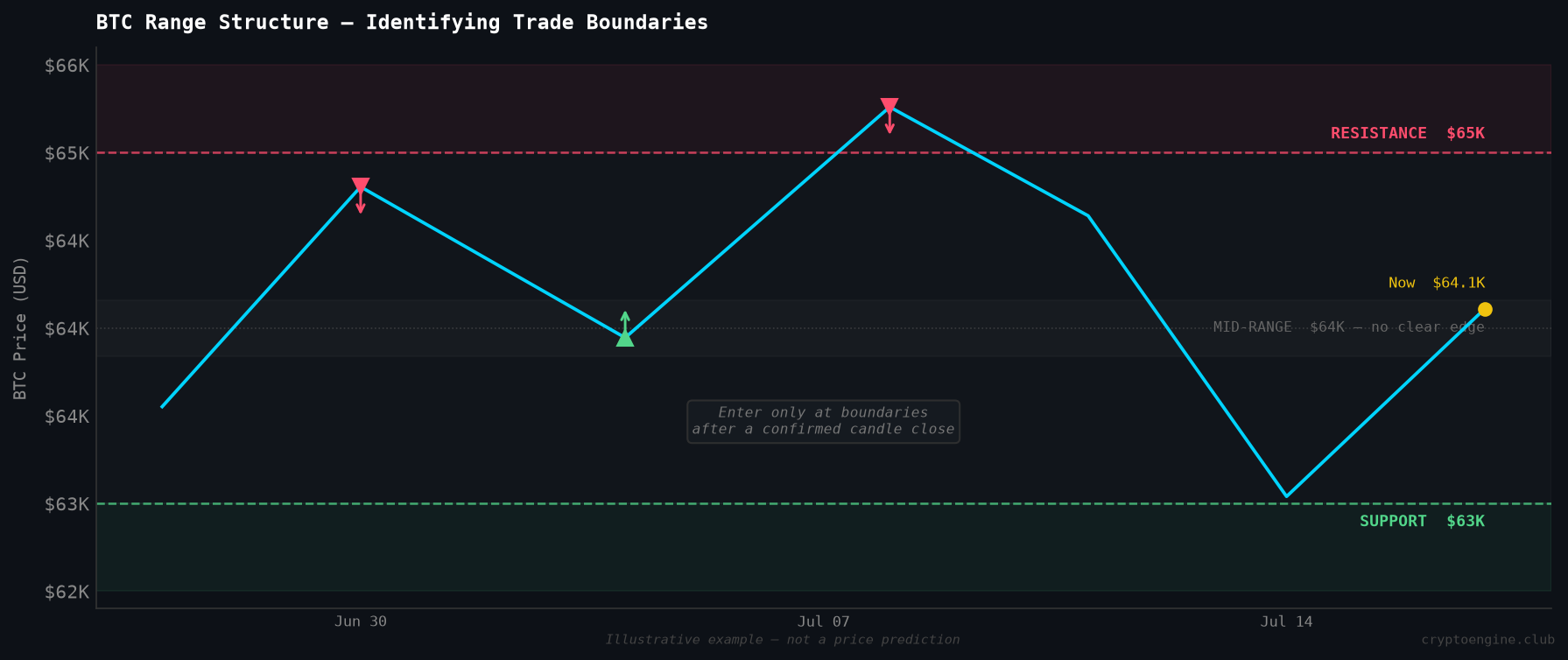
Support-based stops sit just below the floor shown in this range diagram. If that support breaks, the trade thesis is invalidated. That's exactly when you want to be out.
How does Fear & Greed affect where you place your stop?
Market sentiment changes how much room a trade needs.
When Fear & Greed is low (currently 27 (Fear) as of July 17, 2026), BTC tends to swing harder in both directions. Panic selling creates sharp drops that reverse within hours. A stop that's too close to entry will catch those drops instead of riding them out.
In a fear environment, you generally need a wider stop. That means either accepting more dollar risk per trade, or trading a smaller position to keep dollar risk constant. There's no version where you get a tight stop AND avoid fear-driven volatility. One of those gives.
RSI adds another layer. BTC's RSI is at 52.4 on July 17, neutral, not overextended. That matters for stop placement because it tells you where the trade is in its cycle. A neutral RSI with BTC roughly flat over the past week (+0.4% 7-day) means the move isn't exhausted in either direction. Your stop doesn't need to account for an imminent reversal. Just normal volatility.
If RSI were above 75, the trade would be more fragile and the stop might need to be tighter, or the position smaller. Near 52, there's room. For a deeper look at how RSI and Fear & Greed line up to time an entry in the first place, see when to buy Bitcoin: RSI and Fear & Greed signal timing.
How CryptoEngine approaches stop-loss placement
CryptoEngine's signals include a specific stop-loss level with every alert. That stop is set based on technical structure at the time the signal fires, not an arbitrary percentage or a guess.
The current LONG signal, active since July 14 with entry at $64,829, cited "uptrend breaking above resistance" as its reason. BTC has since pulled back to $64,136, about 1.1% below entry. That's the kind of pullback a well-placed stop is built to absorb: the stop for this trade belongs below the resistance level that just became support, not at the entry price itself. If BTC falls back below that support, the breakout has failed and the trade should exit.
Good stop placement looks like this: the stop is at the price where the trade thesis is explicitly wrong. Where the market structure has told you the call didn't work, not just where you'd feel uncomfortable with the loss.
CryptoEngine defines that level in advance so you don't have to make the call in the middle of a move. When your stop hits, you don't debate. You're already out.
Not every provider defines a stop this precisely. If you're still evaluating services, how to tell if a crypto signal service is legitimate covers the questions worth asking before you trust one with real capital.
Common mistakes traders make with Bitcoin stop-losses
Setting stops at round numbers. $60,000, $62,000, $65,000: these are where stops concentrate, which makes them targets. Move your stop 200-400 points away from any obvious round level to get off the cluster.
Widening the stop after price moves against you. This is the most expensive mistake. BTC drops within $300 of your stop and you move it wider to "give the trade more room." That's how a 5% loss becomes a 15% loss. If your original stop level was set correctly, hold it. If it wasn't, that's a pre-trade sizing problem.
Using the same stop distance for every trade. A stop on a high-momentum breakout should be set differently than a stop on a range-fade entry. Volatility changes. The setup matters. Your bitcoin stop loss should match the trade structure, not a template you carry from one position to the next.
How it all fits together
A stop-loss doesn't work in isolation. It's one piece of a three-part trade plan: entry, stop, and target.
Your stop determines the potential loss on a trade. That number, combined with how much capital you're willing to risk per trade (typically 1% of your account, as covered in the position sizing guide), tells you how large your position should be.
Sentiment and momentum then tell you how much room to give the trade. High fear and elevated volatility means a wider stop, but a smaller position to keep dollar risk flat. Low fear and a tight range means a tighter stop and more size at the same dollar risk.
CryptoEngine's signals tie these together: entry price, stop level, and the technical context that justifies both. The trade plan exists before the trade is placed. You know what you're risking and where you're wrong before you click buy. If you're still comparing services, what to look for in a bitcoin trading signal breaks down which features actually matter.
Frequently Asked Questions
What is a bitcoin stop-loss? A bitcoin stop-loss is a pre-set order that exits your BTC position automatically if price falls to a level you specify. It limits how much a trade can cost you by removing the real-time decision when the market moves against you.
Where should I place my Bitcoin stop-loss? The most reliable placement is just below a confirmed support level, a price floor the market has already tested and held. This ensures your stop triggers only when the trade's underlying logic breaks down, not from normal BTC volatility.
Why shouldn't I use round numbers for my stop? Round numbers like $60,000 or $65,000 are where most traders set stops, making them visible targets for liquidity providers. Price frequently dips just below these levels, triggering the stops, then reverses. Placing your stop 200-400 points off the round number reduces that risk.
How does market sentiment affect my stop placement? When Fear & Greed is low (below 30), BTC swings harder. You need a wider stop to survive normal volatility, which means either accepting higher dollar risk or trading a smaller position. High-fear periods aren't the time for tight stops.
Does CryptoEngine include stop-loss levels in its signals? Yes. Every CryptoEngine signal includes a specific stop-loss level based on the technical structure at the time the signal fires. The stop is at the price where the trade thesis is invalidated, not just a fixed percentage below entry.
Bottom line
Traders who last long enough to compound returns in BTC aren't necessarily smarter. They exit losing trades before those trades become catastrophic. A bitcoin stop loss, placed below real structure rather than a round number, is what makes that possible.
Fear & Greed at 27, BTC at $64,136, RSI neutral: this is the kind of market where undisciplined stop placement gets expensive fast. The volatility is there. The crowd is scared. That combination punishes traders who either have no stop or one that's set at the wrong level.
Want a trade plan that includes a stop-loss with every signal? See how CryptoEngine's signals work.
Disclaimer: This article is for educational purposes only and does not constitute financial advice. Past performance does not guarantee future results. Always do your own research before making trading decisions.
Market data via CoinGecko.