How Interest Rates Affect Bitcoin: A Trader's Guide
BTC dropped through its 2022 bear market as the Fed raised rates aggressively; interest-rate cycles are the biggest macro driver of bitcoin price. With rate-hike fears back and BTC at $77,105, here's how to position around Fed decisions.
How Interest Rates Affect Bitcoin: What Fed Decisions Mean for BTC Traders
Interest rates are the single most influential macro force on Bitcoin price, and most retail traders either ignore them or misread the signals. How do interest rates affect Bitcoin? When the Federal Reserve raises rates, borrowing costs rise, risk appetite falls, and capital moves from speculative assets into bonds and cash. When rates drop, cheaper money flows back into risk-on positions, and BTC tends to run.
The relationship is not perfectly mechanical. Bitcoin can rally during tightening cycles and sell off during cuts. But the rate environment sets the background conditions that shape whether bullish setups have follow-through or fade fast.
TL;DR
- Interest rate hikes reduce risk appetite globally; Bitcoin, as a speculative asset, typically faces selling pressure.
- The 2022 bear market unfolded in lockstep with the Fed's most aggressive rate-hike cycle in decades.
- As of September 13, 2026, BTC trades at $77,105 with renewed rate-hike fears returning after stronger-than-expected economic data.
- RSI at 36.3 (Neutral) and Fear & Greed at 61 (Greed) show a mixed picture: sentiment is still risk-on, but momentum is fading.
- CryptoEngine's current signal is SHORT, active since September 10, 2026, with entry at $76,818.
Why Can't Bitcoin Traders Ignore the Fed?
Most BTC traders are chart readers. They watch RSI, support levels, and moving averages. That's useful, but technical setups do not exist in a vacuum. The macro backdrop determines whether a breakout holds or gets crushed.
The Federal Reserve controls the federal funds rate, which flows through to everything: mortgage rates, corporate borrowing, bond yields, and investor appetite for risk. When rates are low, yield-starved investors reach for higher-return assets. Bitcoin was one of the biggest beneficiaries of near-zero rates in 2020 and 2021. When rates spiked, that same capital left.
This is the core mechanic: Bitcoin does not pay a yield. If you can earn 5% risk-free in a money market fund, why hold a volatile, non-yielding asset? Rate hikes shrink Bitcoin's appeal relative to safer alternatives. Rate cuts do the opposite.
How Do Interest Rates Affect Bitcoin Price?
Interest rates affect Bitcoin through three channels: risk appetite, dollar strength, and leverage costs.
Risk appetite is the biggest driver. When rates rise, investors rotate from risk-on assets (growth stocks, crypto, commodities) into fixed income. Bitcoin, which trades like a high-beta tech stock, gets hit. When rates fall, the reverse rotation happens.
Dollar strength matters because Bitcoin is priced in dollars. Rate hikes typically strengthen the dollar (higher yields attract foreign capital). A stronger dollar makes dollar-priced assets like BTC more expensive in local currency terms, suppressing foreign demand.
Leverage costs shape the market's structural behavior. Most crypto traders use borrowed capital. When borrowing is cheap, leverage runs high and markets move faster in both directions. When rates rise and margin gets expensive, speculative positions get unwound. The 2022 cascade of crypto blowups had a significant leverage-unwind component on top of the rate-driven sentiment shift.
| Rate Environment | Fed Action | What Typically Happens to BTC |
|---|---|---|
| Rising rapidly | Rate hikes | Risk-off: selling pressure, leverage unwinds |
| Peaking/holding | Pause | Uncertainty; range-bound or slow recovery |
| Falling | Rate cuts | Risk-on: BTC tends to lead the rally |
| Near-zero floor | Extended hold | Extended bull conditions, high leverage |
This is a simplification. The path matters as much as the level. Markets often price in rate changes months before they happen, so BTC can sell off into a rate hike and recover before the first cut.
What Do Rate Hikes Actually Do to Bitcoin?
The 2022 bear market is the clearest modern example. The Fed began raising rates in March 2022 from near zero. By year-end, rates had climbed dramatically in one of the sharpest tightening cycles in decades. Bitcoin fell from roughly $48,000 at the start of 2022 to around $16,000 by November. That is not a coincidence.
Several things happened simultaneously: leveraged positions got liquidated, institutional investors pulled back from risk assets, and retail traders who borrowed against BTC faced margin calls. The rate hikes did not cause the collapse alone. Structural failures (Terra/Luna, FTX) added to the damage. But the rate environment set the conditions where any shock could cascade.
The key lesson: high rates remove the cushion. In a zero-rate environment, bad news gets bought. In a high-rate environment, bad news gets sold hard because there is a safer alternative.
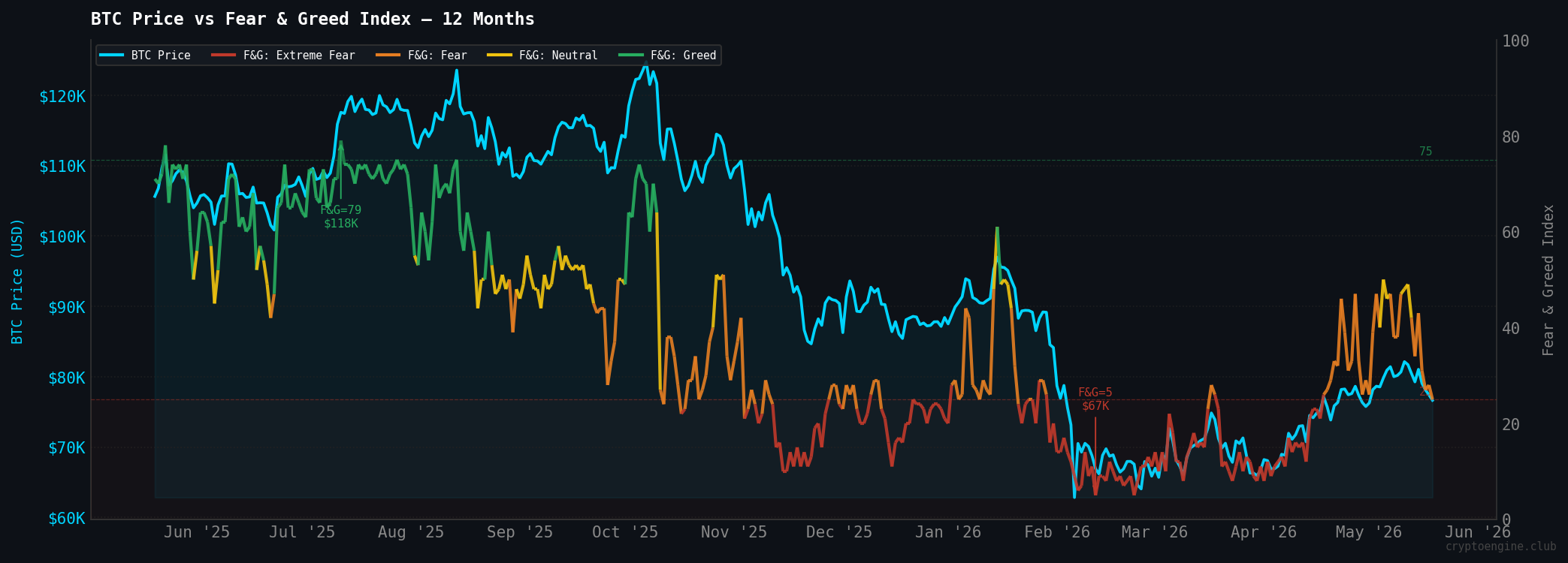
The chart above shows how sentiment and price move in lockstep. When macro fear spikes (often triggered by rate decisions), sentiment drops fast and BTC follows.
Fast-forward to September 13, 2026. BTC sits at $77,105 with renewed rate-hike fears entering the market. CoinDesk reported an economist arguing that the Fed's rate posture "is about Wall Street, not inflation." Whether or not you buy that framing, it tells you the rate debate is back in the headlines.
Fear & Greed at 61 (Greed) tells you the market is still positioned risk-on. RSI at 36.3 is neutral — there's no clear momentum in either direction. The market is not panicking yet, but it is not confident either.
CryptoEngine's active signal is SHORT since September 10, 2026, with entry at $76,818. The reason logged was "Uptrend falling below support." That is a technical read, not a macro call. But the macro setup (rate-hike risk returning) supports a cautious posture. The 3-day return on that SHORT is +0.3%, with BTC currently at $77,105, up 0.4% from entry.
You do not need to predict the CPI print. What you do need is to know which rate environment you are trading in. Right now, the uncertainty itself is the signal.
How CryptoEngine Accounts for Macro in Its Signals
CryptoEngine's signals combine technical structure (support/resistance, momentum), RSI, BTC dominance, and Fear & Greed context to form a complete trade plan with entry price, stop-loss, and take-profit levels. Macro conditions like rate expectations show up indirectly through the sentiment and momentum readings: when rate fears are rising, Fear & Greed typically drops and RSI loses steam.
CryptoEngine has logged every signal publicly; its last 10 completed signals returned a 10/10 win rate over 5-trading-day windows. That track record holds across different rate environments, which reflects that the signal framework adapts to conditions rather than assuming a permanent bull market.
If you want to understand how those signals incorporate multiple data points into a trade decision, the breakdown in How to Know When to Buy Bitcoin: RSI, Fear & Greed, and Signal Timing is worth reading before diving into live signals. You can see current signal details and subscribe at CryptoEngine.
Three Mistakes Traders Make Around Rate Decisions
-
Trading the headline, not the price. "The Fed raised rates by 0.25%" lands in your news feed. Many traders immediately sell. But markets often price in rate hikes weeks in advance. Selling on the announcement can mean selling at a local low after the news is already in the price. Watch what BTC does after the announcement, not at the moment of it.
-
Assuming rate cuts automatically mean BTC pumps. Rate cuts are bullish macro, but they're often made for bad reasons: recession fears, credit stress, financial system cracks. The 2008 Fed cuts did not help risk assets. A rate-cut environment is only clearly bullish for BTC once fear is gone and liquidity is genuinely flowing. Before that, cuts can signal "something broke."
-
Ignoring rates because "crypto is different." It was different in 2017. Post-2020, Bitcoin trades with significant correlation to the Nasdaq and other risk assets during macro stress events. The correlation is not 1:1, but when institutional money moves because of rates, it moves out of BTC too. Learning to use a proper stop-loss as in How to Set a Stop-Loss for Bitcoin Trading protects you when macro shifts hit faster than your technical setups can adapt.
How Rate Cycles, Momentum, and Signals Fit Together
Rate environment alone is not a trading strategy. You still need technical confirmation. The most useful thing the rate cycle does is tell you whether to be aggressive or conservative with your position sizing.
In a rate-cutting environment, buy setups from bitcoin technical analysis have more follow-through. Risk-on sentiment provides wind at the back. You can take larger positions with tighter stops because breakouts tend to hold.
In a rate-hiking environment, the same setups resolve differently. Breakouts fail more. Support levels break and get retested from below. It is the environment where having a pre-set stop-loss matters most.
The CryptoEngine signal framework layers macro context (Fear & Greed, RSI) on top of price structure precisely because technical setups behave differently depending on the backdrop. When all three align (fear or greed in the right direction, RSI confirming momentum, and price structure giving a clear entry), the signal fires. Macro clarity is part of what creates that alignment.
If rate hike fears are putting macro conditions in doubt and a crypto bull run looks less certain, CryptoEngine's signals tend to reflect that through a more defensive signal posture (SHORTs, or fewer LONG entries). You can see that happening right now with the active SHORT since September 10.
Rate cycle + momentum + price structure = the full picture. Any one in isolation is incomplete.
Frequently Asked Questions
What is the relationship between interest rates and Bitcoin? Bitcoin tends to fall when interest rates rise and rally when rates drop. Higher rates make safer assets like bonds more attractive, reducing demand for speculative assets like BTC. Lower rates push investors toward risk-on positions, and Bitcoin historically benefits from that rotation.
Does Bitcoin go up when interest rates drop? Often, yes. But not always immediately. Rate cuts can signal economic problems, which initially spook markets. Once the fear passes and liquidity improves, BTC typically responds positively to lower rates. The clearest gains come when rate cuts happen alongside improving sentiment, not when they happen in a panic.
Why did Bitcoin fall so much in 2022? The 2022 bear market coincided with one of the Federal Reserve's sharpest rate-hike cycles in decades. As rates rose from near zero, investors rotated out of speculative assets. Bitcoin, priced in dollars and offering no yield, faced sustained selling. Structural failures in the crypto market (major exchange and protocol collapses) deepened the decline.
Should I sell Bitcoin before a rate hike? Rate hikes are often priced in weeks before they happen. Selling on the announcement can mean selling after the move is already done. A better approach: watch the market's reaction in the days after an announcement to see if the rate-hike narrative is being absorbed or is causing ongoing fear. Use signals and technical structure rather than reacting to the headline alone.
Does the Fed directly control Bitcoin's price? No. The Fed sets monetary policy for the US dollar. It has no direct influence on Bitcoin. But because Bitcoin is priced in dollars and trades alongside other risk assets, Fed policy shapes the liquidity environment and investor risk appetite, both of which flow through to BTC. It's an indirect but powerful relationship.
Disclaimer: This article is for educational purposes only and does not constitute financial advice. Past performance does not guarantee future results. Always do your own research before making trading decisions.