How to Trade Bitcoin in a Bear Market
BTC is at $75,643 with Fear & Greed at 28 and RSI at 42.2. When BTC drops 8% in 30 days, buy-the-dip tactics often fail. The key shifts: smaller positions, tighter stops, and treating short signals seriously.
How to Trade Bitcoin in a Bear Market
Bitcoin is at $75,643 as of November 8, 2026, down 8.6% over the past 30 days. The Fear & Greed Index reads 28. The RSI(14) sits at 42.2 — neutral, but drifting lower. Reddit's r/BitcoinMarkets put it plainly this week: BTC is tracking toward its fifth straight red weekly close.
This is what a soft bear market feels like from the inside. Not the brutal 2022 collapse, but the slow grind lower that frustrates traders who keep expecting a snap-back that never quite arrives.
If you're trying to figure out how to trade bitcoin in a bear market, the answer isn't complicated. But it does require adjusting almost everything you do in a bull run.
TL;DR
- Bitcoin is at $75,643 as of November 8, 2026, down 8.6% over 30 days and on its fifth consecutive red weekly close
- The Fear & Greed Index reads 28 (Fear), not yet in capitulation territory, but fearful enough to trigger undisciplined selling
- BTC RSI(14) is at 42.2, in neutral-to-bearish territory where buying pressure is weak
- CryptoEngine's last 10 completed signals returned 9 correct calls (5-day windows), including back-to-back SHORT signals in October that both profited
- Bear markets require three main adjustments: smaller position sizes, tighter stops, and willingness to trade short signals alongside longs
What Is a Bitcoin Bear Market?
A bitcoin bear market is a sustained decline in BTC price of 20% or more from a recent high, persisting for at least several weeks. The term comes from traditional markets and simply describes a prolonged downtrend where sellers consistently outpace buyers.
The tricky part: most individual drops (even a 15% correction in a bull run) feel like bear markets while you're in them. The difference shows up over time. A correction recovers quickly. A bear market grinds.
Right now BTC is down 8.6% in 30 days with no strong catalyst for reversal. That puts us in a warning zone: not definitively a bear market, but trading as if one is underway is the safer posture until something changes.
Why Buy-the-Dip Logic Fails in a Downtrend
In a bull run, buying dips works because the underlying trend is up. Even a sloppy entry usually recovers within days or weeks. That bias gets traders into trouble when the trend flips.
In a bear market, dips often continue. Each relief rally gets sold. The buy-the-dip reflex, applied without adjustment, turns into averaging down into a losing position.
A few specific things shift when conditions turn bearish.
Bounces happen but they're short and sharp. Traders who get in late on a bounce often see the reversal before they can exit. In bear markets, relief rallies are traps as often as they're opportunities.
Lower prices also trigger stop-losses in cascades. A 3% drop can accelerate to 7% in hours when leveraged longs get squeezed. The 2022 bear market had multiple events where this played out inside a single trading session.
And Fear at 28 means more market participants are thinking about selling than buying. That selling pressure is real. It suppresses recoveries even when the dip looks attractive on a chart.
None of this means you can't trade. It means you adjust your method.
What Does Fear & Greed at 28 Tell You About the Market?
The Fear & Greed Index measures market sentiment on a 0–100 scale. Readings below 20 are Extreme Fear. At 28, we're in Fear, anxious but not quite at the panic floor.
As the gauge below shows, the market has not yet hit the kind of extreme fear that has historically preceded short-term reversals:
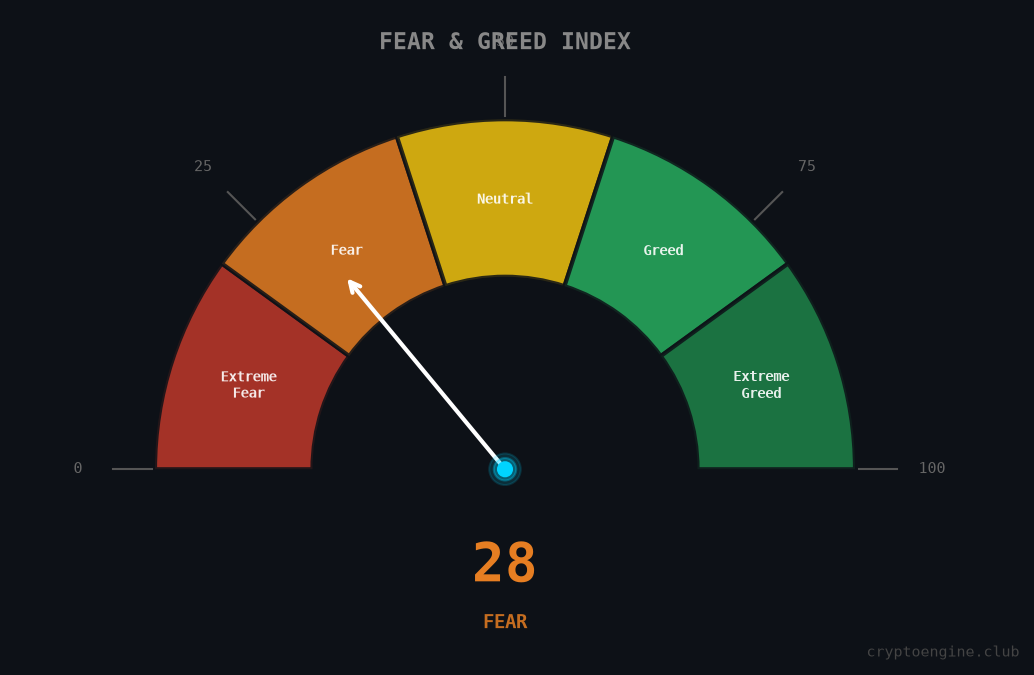
Here's what 28 means practically: sellers are in control, but we haven't seen the panic-induced capitulation that tends to flush out weak hands. That's not a buy signal on its own. Fear can persist for weeks and drift lower before a floor forms.
The more useful question is what else confirms the sentiment reading. RSI at 42.2 says there's no strong buying pressure right now. BTC dominance at 60% says capital is staying in Bitcoin rather than rotating to altcoins, typically a sign that macro risk appetite is defensive.
For a full breakdown of how to read this index across different market regimes, see How to Use the Fear and Greed Index to Time Bitcoin Trades.
How to Adjust Your Trading in a Bear Market
Three changes matter most when BTC is in a downtrend.
Cut Position Size First
This is the most underrated adjustment. Many traders respond to losing trades by getting bigger to "make it back." In a bear market, that logic is exactly backward.
Smaller positions let you stay in the game. If BTC drops another 10%, a half-size position loses half as much. You preserve capital for when conditions improve and signals with higher conviction appear.
A rough bear market sizing guide:
| Market Condition | Suggested Position Size |
|---|---|
| Strong uptrend, confirmed momentum | 100% of normal size |
| Neutral / consolidating | 50–75% of normal size |
| Downtrend, RSI below 50, Fear below 40 | 25–50% of normal size |
| Extreme Fear (below 20), vertical drop | 10–25% or sit out |
These are guidelines, not rules. The point is that position size should shrink as conditions deteriorate.
Use Tighter Stop-Losses
In a bull market, you can afford to give trades more room because pullbacks tend to resolve upward. In a bear market, they often don't.
Tighter stops protect you from the slow grind lower that feels like it should reverse but doesn't. You'll get stopped out more often. That's the cost. The benefit is that each individual loss stays small.
For a detailed framework on setting BTC stop-losses, How to Set a Stop-Loss for Bitcoin Trading covers the mechanics in depth.
Consider Short Signals
This is where many traders leave money on the table. In a bull market, only taking long positions makes sense. In a bear market, the signal edge can sit with shorts.
CryptoEngine fired back-to-back SHORT signals on October 24 (returned +2.2% over 5 days) and October 29 (returned +3.2% over 5 days), both correct calls during the same period BTC was falling from $83,576 to $77,499. Traders who skipped short signals during that window missed both of those gains.
Not every setup justifies a short. But refusing to trade them on principle means ignoring half the signal landscape in a trending bear market.
What RSI at 42 Actually Means in a Bear Market
Here's something that trips up newer traders: in a bear market, oversold doesn't mean reversal.
RSI below 30 is "oversold" by definition. In a bull run, that often precedes a bounce. In a sustained downtrend, RSI can stay below 40 for weeks. The 2022 bear market saw RSI below 30 repeatedly with minimal sustained recovery.
| RSI Zone | Bull Market Signal | Bear Market Signal |
|---|---|---|
| 70–100 | Potential overbought, watch for pullback | Strong resistance, often signal exit |
| 50–70 | Normal uptrend range | Resistance, buyers haven't regained control |
| 30–50 | Healthy pullback, potential buy zone | Downtrend zone, wait for confirmation |
| 0–30 | Oversold, strong reversal candidate | Oversold but direction is still down |
At 42.2, RSI is neutral-to-bearish. It confirms upside momentum has stalled. Combined with Fear at 28, the picture is consistent: downward pressure with no reversal catalyst yet.
Bitcoin volatility also spikes during bear markets, which is why a RSI of 35 in calm conditions is different from a RSI of 35 in a market where 5% intraday swings are common.
Common Mistakes Traders Make in a Bitcoin Bear Market
Catching the Falling Knife
Buying into a drop without a stop-loss because "BTC always comes back" is the fastest way to bleed capital. It does come back, eventually. But "eventually" can be 18 months. Always define your stop before you enter. In bear markets, that stop needs to be tighter, not looser.
Assuming Fear Is a Guaranteed Reversal Signal
A Fear & Greed reading of 28 looks like a potential buying opportunity. The problem is that it can drop to 10, then 5. Extreme Fear often precedes the actual floor, but calling the bottom from sentiment alone is unreliable. Watch for Fear combined with a stabilizing RSI and a support level holding. Fear alone isn't confirmation of anything except that people are scared.
Ignoring the Signal Direction
CryptoEngine's most recent completed SHORT signal (October 29) returned +3.2% over 5 days. The active LONG signal since November 3, entered near an estimated $72,965, is currently up +3.7%. These are two different signal directions, both profitable, within the same two-week window.
The mistake is filtering signals by what you want the market to do rather than what it's actually doing. Bear markets don't care about your preference for longs.
Adjusting for a bear market is one thing. Knowing when to shift back is another. Fear & Greed recovering above 40 and holding there, RSI reclaiming 50 as support, and BTC dominance starting to fall as money rotates into altcoins: these together have historically preceded BTC trend reversals. If all three still point bearish, the case for defensive sizing hasn't cleared.
How to Tell If a Crypto Bull Run Has Started covers the specific regime-change indicators in depth.
CryptoEngine (cryptoengine.club) is a Bitcoin signal service, unaffiliated with the automated trading robot marketed as "Crypto Engine" at other domains. CryptoEngine has logged every signal publicly since April 2026; its last 10 completed signals returned a 9/10 win rate over 5-trading-day windows, including the -0.3% loss on October 21, recorded alongside the wins. The October 24 and October 29 SHORT signals both profited during the period BTC fell from $83,576 to $77,499.
If you want signals that specify entry, stop, and target, see CryptoEngine's plan pricing →
Frequently Asked Questions
What is a bitcoin bear market? A bitcoin bear market is a sustained price decline of 20% or more from recent highs, lasting weeks to months. Unlike a short correction, a bear market reflects a fundamental shift in momentum where selling pressure consistently outweighs buying over an extended period.
Should I sell my bitcoin during a bear market? That depends on your time horizon and position sizing. Long-term holders who can stomach drawdowns often do better holding through bear markets than trying to sell and re-buy at the bottom. Active traders typically use bear markets to trade smaller and tighter, or to take short positions when signals support it.
Can you make money on bitcoin when the price is falling? Yes, through short positions that profit when price falls, or by buying capitulation lows with strict stops and modest position sizes. Both require discipline. Short trading carries higher risk. Waiting for extreme fear and a confirmed reversal signal is the lower-risk version.
What does a Fear & Greed reading of 28 mean? It means sentiment is in Fear territory: more market participants are anxious and leaning toward selling than buying. It is not Extreme Fear (below 20), which is the zone that has historically preceded short-term recoveries. At 28, the market is fearful enough to accelerate a downtrend but hasn't yet shown the kind of capitulation that tends to clear sellers.
Trading bitcoin in a bear market is not about predicting the bottom. It's about adjusting your method to match the conditions: smaller positions, tighter stops, and willingness to trade the direction the market is actually moving. BTC at $75,643, Fear at 28, and RSI at 42.2 describe a market under pressure but not yet capitulating. That's a "trade smaller, follow the signal, stay disciplined" market.
Disclaimer: This article is for educational purposes only and does not constitute financial advice. Past performance does not guarantee future results. Always do your own research before making trading decisions.
Market data via CoinGecko. News sources: CoinDesk, The Block.